RoHS Supplier Documentation: What to Request and Check
A practical guide to requesting, checking and organising RoHS and REACH supplier evidence, with a reusable request template and escalation workflow.
Table of Contents
TL;DR: what supplier evidence do you need for RoHS?
For electronics within the scope of EU RoHS, collect evidence that connects the components and materials in your product to the applicable substance restrictions. Depending on the risk and the information available, that evidence may include supplier declarations, material declarations and test reports. There is no universal requirement to obtain a third-party “RoHS certificate” for every component.
The difficult part is establishing whether the documents actually cover what you buy. A PDF with the right logo can still refer to the wrong part, omit an applicable restriction or leave an exemption unexplained. An unanswered supplier request is an evidence gap; it is not, by itself, proof that the component is non-compliant.
This guide gives electronics manufacturers and importers a practical request template, document checklist and escalation workflow. It focuses on supplier evidence for EU RoHS and related REACH substance information, rather than every requirement involved in placing a product on the market.
Why is supplier compliance documentation so difficult to collect?
Your purchasing team orders a distributor’s stock code. Engineering uses the manufacturer’s part number. The supplier sends a declaration for a product family. Nobody has recorded whether that family includes the connector actually fitted to your latest production revision.
That is a traceability problem, even if each team has done what it was asked to do.
Other recurring obstacles are equally practical:
- The sales contact can provide a catalogue, but needs the quality team to answer substance questions.
- A generic declaration says “RoHS compliant” without identifying its product coverage or the basis for the statement.
- A test report covers one material or sample, while the assembly contains several other materials.
- The supplier changes a coating, cable or sub-supplier without a clear route for notifying your compliance team.
- Composition data is commercially sensitive, so the supplier offers a limited declaration instead of a full material breakdown.
- Documents arrive in separate inboxes, making it hard to see which questions remain open.
Sending more reminders will not resolve an unclear request. First define the product, the question and the evidence you need. Then make the response easy to provide.
Is a supplier’s RoHS certificate enough?
Not necessarily. “RoHS certificate” is a common search term, but the document’s title does not establish its evidential value. Check its scope, issuer and connection to the product.
Under Directive 2011/65/EU, Article 7, manufacturers must prepare technical documentation and carry out the required conformity assessment. They retain the technical documentation and EU Declaration of Conformity for ten years after the electrical or electronic equipment is placed on the market. Collecting supplier files supports that work; it does not transfer the manufacturer’s responsibility.
Commission Implementing Decision (EU) 2020/659 lists EN IEC 63000:2018 as a harmonised standard for assessing technical documentation concerning hazardous-substance restrictions. Use that framework with competent technical judgement, rather than treating the number of uploaded PDFs as a measure of compliance.
On smaller screens, swipe the table sideways to see every column.
| Document | What it can help establish | What to check |
|---|---|---|
| Supplier RoHS declaration | The supplier’s stated conformity position for identified products. | Exact part coverage, applicable requirements and any exemptions. |
| Material declaration | Substance or composition information for specified materials or parts. | Coverage, reporting thresholds, revisions and missing information. |
| Laboratory test report | Results for the sample, substances and methods tested. | Sample identity and whether the results are relevant to your production part. |
| EU Declaration of Conformity | The manufacturer’s formal declaration for the identified finished product. | Relevant legislation, product identity and supporting technical documentation. |
| REACH SVHC declaration | Information about Candidate List substances within its stated scope. | List date, article coverage and any substances requiring communication. |
If you are reviewing wider CE evidence, use our separate guide to checking supplier CE test reports.
What should you check in a supplier RoHS declaration?
Use these seven checks as a practical review checklist. They are not a claim that every supplier document must follow one legally prescribed template.
- Product identity: does the evidence cover the manufacturer’s part number, including the relevant suffix, variant or revision? Record the link to your internal and distributor codes.
- Legal scope: does the statement address EU RoHS as amended and the applicable restricted substances? A vague “environmentally friendly” claim is not a substitute.
- Exemptions: if the supplier relies on an exemption, is it identified clearly enough to assess its applicability to your product category and relevant dates?
- Material coverage: does the evidence address the complete supplied part, or only selected materials? Identify any unassessed housing, coating, cable or accessory.
- Source and traceability: can you identify the issuing company, document date or revision and a contact who can clarify its scope?
- Supporting basis: where uncertainty or risk warrants it, can the supplier explain the basis for its statement or provide relevant supporting information?
- Change control: is the evidence still applicable to the part being purchased today? Record what would trigger a review.
Do not automatically reject a declaration because it is more than twelve months old. Equally, do not accept a recent document simply because its date looks reassuring. Relevance depends on product changes, the requirements assessed and the evidence itself.
What should you ask your supplier to send?
Send a specific request with a short parts list. Ask the supplier to identify unknowns explicitly instead of encouraging a blanket “yes”. The following template is a practical starting point; adjust it to your product and role.
Subject: RoHS and REACH information request — [manufacturer part numbers]
We are reviewing the evidence for the components listed below for use in electronics intended for the EU market.
Please confirm which documents cover each manufacturer part number and revision. Where our purchasing code differs from yours, please confirm the mapping.
For RoHS: please provide your declaration addressing Directive 2011/65/EU as amended, identify any exemptions relied upon, and indicate any exclusions or information gaps. Please share available supporting material declarations or relevant test reports where appropriate.
For REACH: please identify the Candidate List date covered by your response and provide any applicable information about Candidate List substances above 0.1% weight by weight in the relevant articles. Please distinguish confirmed absence within your assessment scope from information that is unavailable.
Please identify the issuing organisation and document date or revision, and let us know whom to contact about future material or component changes.
If you cannot provide part of this information, please explain what is missing and whether the original manufacturer or another technical contact can help.
Requested response date: [commercial project deadline]. Parts and revisions: [list]. Contact for questions: [name and email].
Your requested response date is a project deadline, not a universal statutory deadline for supplier documentation. If sensitive composition information is involved, discuss an appropriate confidential route or alternative evidence with the reviewer.
{{cta}}
How do you turn supplier replies into a usable evidence register?
Keep one line for each component or clearly defined component group. Link the evidence to the bill of materials and record the reviewer’s decision separately from receipt of the file.
Useful fields are: internal part number, manufacturer part number, revision, supplier, document link, document scope, applicable exemption, REACH list date, unresolved question, owner and review status. Start with simple statuses such as “requested”, “received”, “clarification needed” and “review completed”.
The following is an illustrative example, not an EcoComply customer case.
On smaller screens, swipe the table sideways to see every column.
| Component | Evidence received | Open issue | Next action |
|---|---|---|---|
| Controller board, revision B | RoHS declaration for revision A | Coverage of the revised assembly is unclear. | Ask the manufacturer to confirm the changes and evidence applicability. |
| Replacement connector | Distributor’s general compliance statement | No mapping to the manufacturer’s exact part number. | Obtain the mapping and product-specific coverage. |
| Cable assembly | REACH SVHC statement | RoHS evidence has not been supplied. | Request RoHS information separately. |
None of these rows justifies an automatic “compliant” label. Each gives the reviewer a specific next question. That makes progress visible without overstating what the evidence proves.
What if the supplier cannot provide the documents?
Escalate the uncertainty in a controlled sequence:
- Reach the right person. Ask the sales contact to involve quality, regulatory affairs or the original manufacturer.
- Narrow the gap. Explain whether you need a part-number mapping, an exemption reference, material coverage or evidence for a changed revision.
- Assess alternative evidence. A competent reviewer may be able to use other reliable information. Record why it is relevant and where uncertainty remains.
- Decide whether targeted testing is needed. Testing should address the unresolved question. It is not automatically necessary for every component, and an unsuitable test does not close the gap.
- Escalate the product decision. If a material conformity question remains unresolved, involve the responsible technical and compliance decision-makers before approving market placement. A different component or supplier may be necessary.
The commercial cost is often the repeated handoff between purchasing, engineering, suppliers and compliance reviewers. An organised collection process reduces that coordination burden while keeping the technical decision visible.
Does RoHS evidence also cover REACH?
No. The two regimes ask different questions. RoHS restricts specified substances in homogeneous materials within covered electrical and electronic equipment. REACH has wider obligations, including restrictions and duties to communicate information about certain substances in articles.
For REACH Article 33, Candidate List substances above 0.1% weight by weight in an article trigger relevant safe-use information duties, including at least the substance name. For complex products, the threshold is assessed at article level, not simply averaged across the whole finished product. The 45-day consumer-response rule should not be presented as a general deadline for every business-to-business documentation request.
A statement covering Candidate List substances is not a complete assessment of every REACH requirement. Depending on your role and product, SCIP obligations may also need separate consideration.
How can EcoComply help collect supplier evidence?
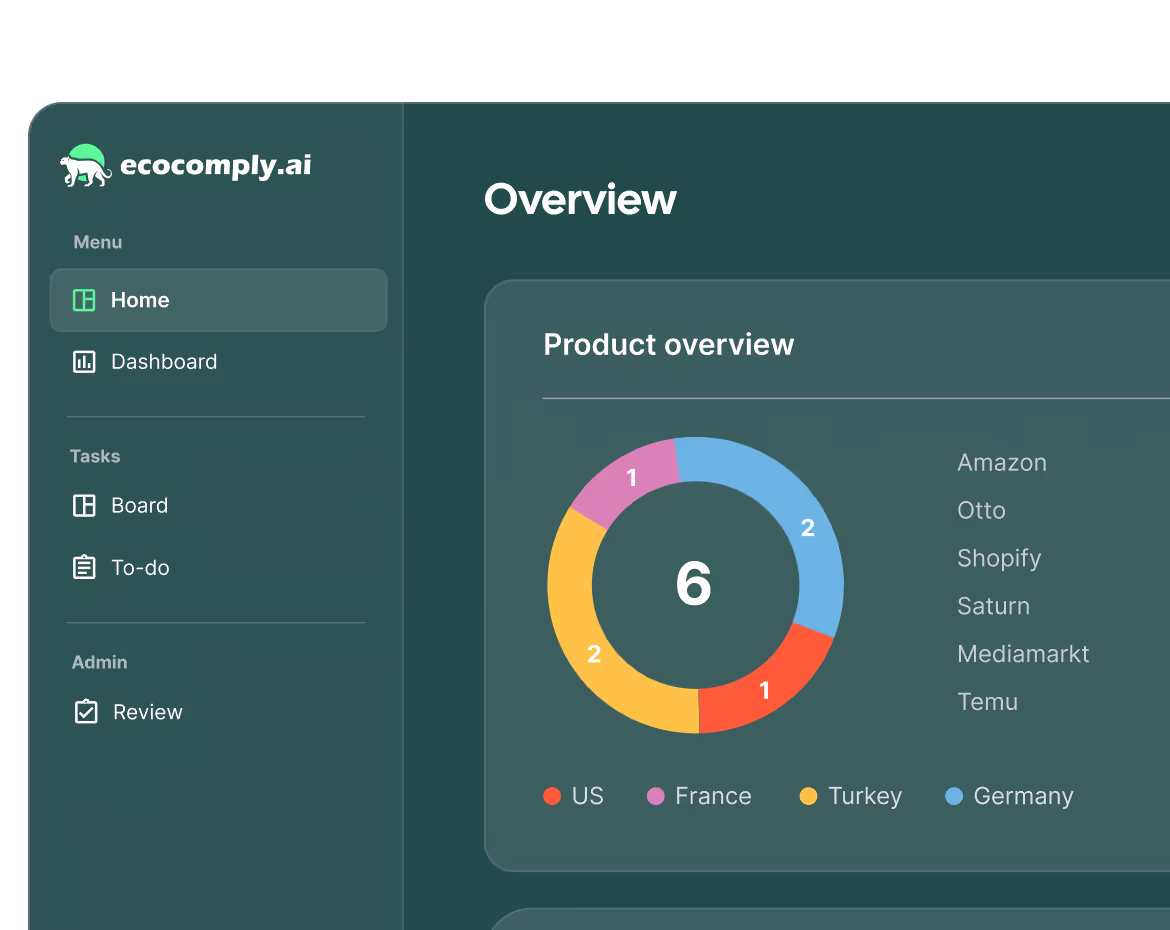
EcoComply’s new supplier evidence collection workflow automates outreach to suppliers and helps them provide the information needed for your project.
Suppliers receive an email invitation and can upload documents or reply directly without creating an account. Documents and conversations stay with the relevant task, so your team and EcoComply’s experts can follow the same request.
The practical value is a clearer path from “we need this document” to “we know what was received and what still needs clarification”. Experts review the evidence; receiving a file alone does not establish compliance.
Managed supplier outreach and document preparation are paid services agreed in the proposal. Discuss your product, supplier list and RoHS or REACH evidence gaps with EcoComply to establish the appropriate scope. See the platform workflow and RoHS compliance support.
How do you keep supplier evidence current?
Make evidence review part of engineering and purchasing changes. A replacement connector, new coating or changed supplier can affect whether earlier documentation remains relevant. Review the changed element and its implications rather than assuming either that nothing matters or that every change requires complete retesting.
Keep the earlier evidence, the updated information and the decision together. For REACH declarations, record the Candidate List date assessed so that later list changes can be evaluated. For RoHS, check relevant amendments and exemption conditions as part of the review.
Our component change review resource provides a related starting point for documenting changes.
Frequently asked questions
Do I need a RoHS certificate for every component?
There is no universal requirement for a third-party RoHS certificate for every component. You need adequate evidence supporting the finished product’s conformity. Depending on the part, risk and available information, this may involve supplier declarations, material data, test reports or a combination of evidence.
Can I accept a generic supplier RoHS declaration?
Potentially, if its scope clearly covers the exact parts supplied and it provides a sufficient basis for your assessment. If product coverage, applicable restrictions or exemptions are unclear, request clarification. A generic statement should not automatically be treated as evidence for every product the supplier sells.
How long is a supplier RoHS declaration valid?
There is no universal twelve-month expiry rule for supplier RoHS declarations. Check whether the evidence remains applicable to the product, materials and requirements assessed. Changes to parts, manufacturing, applicable requirements or exemption conditions can trigger a review even when a document is recent.
What should I do if my supplier does not respond?
Contact the supplier’s quality or regulatory team, identify the exact missing information and seek relevant evidence from the original manufacturer where possible. Escalate unresolved gaps for technical review. Alternative evidence, targeted testing or a different component may be necessary, depending on the remaining uncertainty.
Does a RoHS declaration prove REACH compliance?
No. RoHS and REACH have different scopes and obligations. Request relevant REACH information separately, including the Candidate List date and article coverage for an SVHC statement. That statement alone does not establish compliance with every REACH requirement.
Can EcoComply contact suppliers to collect evidence?
Yes. EcoComply’s supplier evidence collection workflow automates outreach and lets suppliers upload documents or reply without an account. Managed outreach and expert review are scoped in the proposal. Collection supports the assessment; it does not automatically establish product conformity.
Start with the evidence gap that is blocking your product
Bring your bill of materials, supplier contacts, existing documents and target markets. EcoComply can help define the collection and review work needed, with the responsibilities and deliverables agreed before the project starts.
Frequently Asked Questions
Everything you need to know about EU compliance

Still chasing supplier documents?
Give your suppliers a clear route to provide evidence and give your reviewers a clear view of the gaps. Explore EcoComply’s RoHS compliance support and discuss the supplier outreach your project needs.
Discuss your product and compliance needs
Tell us about your product and target markets. Receive an initial requirements assessment and a personalised proposal based on our fixed pricing. No obligation.