RoHS 3: The 10 Restricted Substances and Their Limits
The ten RoHS restricted substances and their limits, why the homogeneous material rule decides compliance, the 11 categories, and the lead exemption changes that took effect on 1 July 2026.

Table of Contents
TL;DR. EU RoHS restricts ten substances in electrical and electronic equipment. Six came from the original directive; four phthalates (DEHP, BBP, DBP, DIBP) were added by Delegated Directive (EU) 2015/863 and have applied since 22 July 2019, or 22 July 2021 for medical devices and monitoring instruments.
The limit is 0.1% by weight for nine of them and 0.01% for cadmium, measured per homogeneous material, not per product. "RoHS 3" is industry shorthand, not a legal term. And on 1 July 2026 the wording of the lead exemptions for solder, glass, ceramic, steel, aluminium and copper changed, with most successor entries expiring in 2027.
What are the 10 RoHS restricted substances?
Annex II of Directive 2011/65/EU lists the restricted substances and, in its own words, the "maximum concentration values tolerated by weight in homogeneous materials." That last phrase does most of the work, and we come back to it below.
| # | Substance | Abbrev. | CAS | Limit | In ppm | Added by |
|---|---|---|---|---|---|---|
| 1 | Lead | Pb | 7439-92-1 | 0.1% | 1,000 | Original six |
| 2 | Mercury | Hg | 7439-97-6 | 0.1% | 1,000 | Original six |
| 3 | Cadmium | Cd | 7440-43-9 | 0.01% | 100 | Original six |
| 4 | Hexavalent chromium | Cr(VI) | substance group | 0.1% | 1,000 | Original six |
| 5 | Polybrominated biphenyls | PBB | substance group | 0.1% | 1,000 | Original six |
| 6 | Polybrominated diphenyl ethers | PBDE | substance group | 0.1% | 1,000 | Original six |
| 7 | Bis(2-ethylhexyl) phthalate | DEHP | 117-81-7 | 0.1% | 1,000 | 2015/863 |
| 8 | Butyl benzyl phthalate | BBP | 85-68-7 | 0.1% | 1,000 | 2015/863 |
| 9 | Dibutyl phthalate | DBP | 84-74-2 | 0.1% | 1,000 | 2015/863 |
| 10 | Diisobutyl phthalate | DIBP | 84-69-5 | 0.1% | 1,000 | 2015/863 |
Cadmium is the only outlier at 0.01%, ten times stricter than everything else. If you remember one number from this table, remember that one, because cadmium turns up in pigments, plating, brazing alloys and older plastics precisely where nobody thinks to look.
Annex II names elements and substance groups, not CAS entries. The restriction covers the element and its compounds as they occur in the material; there is no CAS list in the Directive itself.
When did the RoHS phthalate restrictions take effect?
The four phthalates applied from 22 July 2019 for most categories, and from 22 July 2021 for category 8 medical devices, in vitro diagnostics, and category 9 monitoring and control instruments including industrial ones.
But Annex II also contains three exclusions that are routinely overlooked:
- Legacy cables and spare parts. The phthalate restriction does not apply to cables or spare parts used for the repair, reuse, functionality update or capacity upgrade of EEE placed on the market before 22 July 2019 (before 22 July 2021 for the categories above).
- Toys already covered by REACH. DEHP, BBP and DBP restrictions do not apply to toys already caught by REACH Annex XVII entry 51. DIBP is not in this carve-out, a small drafting detail with real consequences for toy makers.
- Category 11 takes the general date of 22 July 2019.
What "homogeneous material" means in RoHS
If your supplier sends you a test report showing "lead: 0.002% of product weight", that report tells you nothing about RoHS compliance. This is the single most expensive misunderstanding in the whole regime, so it is worth being precise.
Article 3(20) defines it as: "one material of uniform composition throughout or a material, consisting of a combination of materials, that cannot be disjointed or separated into different materials by mechanical actions such as unscrewing, cutting, crushing, grinding and abrasive processes."
Article 4(2) then applies the Annex II limits to each such material. The Commission's own FAQ states it flatly: "All EEE consist of many different homogeneous materials and the maximum concentration values are applied to each of the homogeneous materials individually."
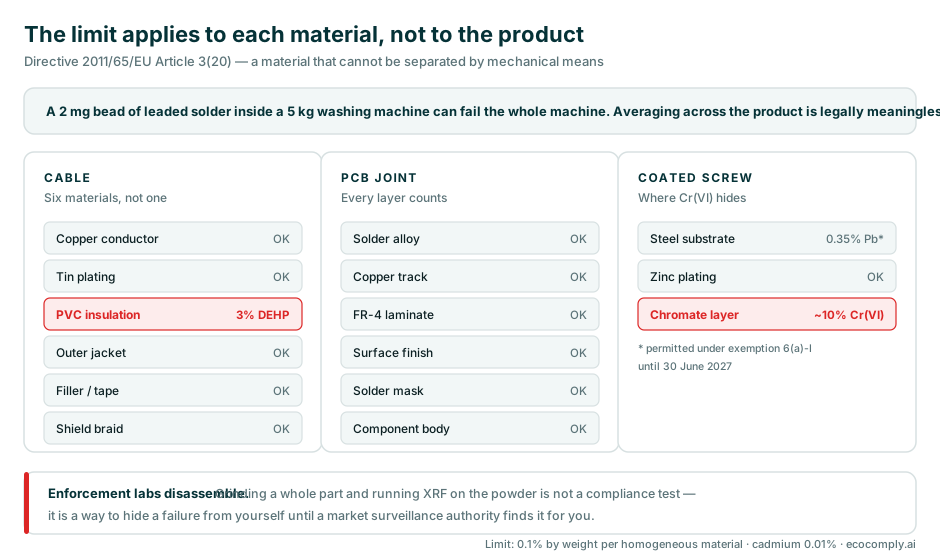
The consequence: a two-milligram bead of leaded solder inside a five-kilogram washing machine can make the whole machine non-compliant.
Diluting across the product is legally meaningless. A product that is 0.0001% lead "overall" fails if any one homogeneous material inside it exceeds 0.1%.
Homogeneous material example 1: a cable is not one material
A single power cable typically contains six or more homogeneous materials:
- Copper conductor (the Commission's FAQ uses "a copper wire inside a cable" as its own example)
- Any tin or silver plating on that conductor, which is a separable layer and so its own material
- The inner insulation
- The outer jacket
- Fillers and tapes
- The shield braid
A PVC insulation plasticised at 3% DEHP fails, even though DEHP across the whole cable mass might come in under 1%. This is the most common cable failure mode and it survives right through to the finished product.
Homogeneous material example 2: one PCB, dozens of materials
A populated board is assessed material by material:
- The solder alloy at each joint is its own homogeneous material, and the Commission FAQ uses "the solder part of a solder joint" as its example
- Copper track: separate
- FR-4 laminate: the cured epoxy-glass composite cannot be mechanically separated, so it is generally one material
- But the surface finish, whether HASL, ENIG or OSP, is a separable layer and is its own material
- Solder mask: separate. Silkscreen ink: separate
- And every component is itself many materials: the moulded epoxy body, the lead frame plating, the die attach, the ceramic dielectric of an MLCC, the internal electrode metallisation
This granularity is exactly why the exemptions are written the way they are. Annex III entry 7(c)-II reads "lead in dielectric ceramic in capacitors for a rated voltage of 125 V AC or 250 V DC or higher". It is drafted at the level of one homogeneous material inside one component.
Homogeneous material example 3: a coated screw, and where Cr(VI) hides
A plated screw is at least three homogeneous materials:
- The steel substrate. Leaded free-machining steel is why exemption 6(a)-I exists, permitting up to 0.35% lead.
- The zinc plating.
- The chromate passivation layer on top of the plating, and this is where hexavalent chromium lives.
A yellow or olive chromate passivation typically runs around 10% Cr(VI) within the coating. That is a hundred times the limit, in a layer whose mass is trivial relative to the screw. The screw fails. The product fails.
There is one practical concession: the Commission FAQ accepts that coatings thinner than 100 nm rarely contain restricted substances and can generally be excluded from analysis, with the express exception of thin passivation coatings, which are precisely the ones that catch you.
How RoHS samples must be prepared for testing
Commission FAQ Q9.8: "Due care and risk considerations should be taken when preparing samples… to assure individual homogeneous materials are adequately separated where homogenising samples may dilute the presence of the restricted substances for the test method applied."
Enforcement labs disassemble. Grinding a whole part and running XRF on the powder is not a compliance test. It is a way to hide a failure from yourself until a market surveillance authority finds it for you.
One relief worth knowing: the restrictions apply to the finished EEE, not the production process. Restricted substances may be used in manufacturing provided the finished product stays within the limits.
{{cta}}
The 11 RoHS categories, and what category 11 really means
| Cat. | Name | Examples | Applies from |
|---|---|---|---|
| 1 | Large household appliances | Fridges, washing machines, dishwashers, cookers, air conditioners | 1 Jul 2006 |
| 2 | Small household appliances | Vacuum cleaners, irons, toasters, coffee machines, hair dryers, shavers | 1 Jul 2006 |
| 3 | IT and telecommunications equipment | PCs, laptops, printers, phones, servers | 1 Jul 2006 |
| 4 | Consumer equipment | TVs, radios, cameras, hi-fi, amplifiers, electronic instruments | 1 Jul 2006 |
| 5 | Lighting equipment | Luminaires, fluorescent tubes, LED lighting | 1 Jul 2006 |
| 6 | Electrical and electronic tools | Drills, saws, sanders, lawnmowers, sewing machines | 1 Jul 2006 |
| 7 | Toys, leisure and sports equipment | Train sets, handheld consoles, bike and dive computers | 1 Jul 2006 |
| 8 | Medical devices | Radiotherapy, dialysis, ventilators, IVD analysers | 22 Jul 2014; IVDs 22 Jul 2016 |
| 9 | Monitoring and control instruments | Smoke detectors, thermostats, lab instruments, industrial control panels | 22 Jul 2014; industrial 22 Jul 2017 |
| 10 | Automatic dispensers | Vending machines, ATMs | 1 Jul 2006 |
| 11 | Other EEE not covered above | Open catch-all | 22 Jul 2019 |
Category 11 reversed the logic of the whole regime. Under RoHS 1, a product was in scope only if it fitted a listed category. Under RoHS 2, all EEE is in scope unless expressly excluded.
If your product does not obviously fit categories 1 to 10, that is not an escape route. It is category 11, and it has been in scope since 22 July 2019.
Typical category 11 products: e-cigarettes, e-bikes that are not type-approved, cables sold as products in their own right, electrical accessories, USB gadgets, and the long tail of smart-home devices that fit no other bucket.
The exclusions in Article 2(4) are a closed list: military and security equipment; equipment for space; equipment specifically designed as part of out-of-scope equipment; large-scale stationary industrial tools; large-scale fixed installations; means of transport for persons or goods (except non-type-approved electric two-wheelers); non-road mobile machinery for professional use only; active implantable medical devices; professionally installed fixed photovoltaic panels; business-to-business R&D equipment; and pipe organs.
EEE itself is capped at 1,000 V AC or 1,500 V DC.
RoHS 1 vs RoHS 2 vs RoHS 3
Before the comparison, the correction: "RoHS 3" is industry shorthand, not a legal term. No EU legal act, no Commission page and no EUR-Lex document uses it.
What exists is Directive 2011/65/EU as amended, most significantly by Delegated Directive (EU) 2015/863, which replaced Annex II and took the list from six substances to ten.
So when a supplier sends you a "RoHS 3 certificate", it is a marketing artefact. What you actually need is a conformity claim against Directive 2011/65/EU, which since 22 July 2019 necessarily covers all ten substances.
| RoHS 1 | RoHS 2 | "RoHS 3" | |
|---|---|---|---|
| Instrument | Directive 2002/95/EC | Directive 2011/65/EU (recast) | Delegated Directive (EU) 2015/863 |
| Applied from | 1 July 2006 | Transposition 2 Jan 2013 | 22 Jul 2019 / 22 Jul 2021 |
| Substances | 6 | 6 | 10 |
| Scope | Categories 1–7 and 10 only | Categories 1–11, incl. medical, monitoring and open catch-all | unchanged |
| CE marking | No | Yes (Art. 15) | unchanged |
| EU Declaration of Conformity | No | Yes (Art. 13 + Annex VI) | unchanged |
| Conformity assessment | None specified | Module A internal production control | unchanged |
| Economic operators | "Producer" only, thinly defined | Full chain: manufacturer, AR, importer, distributor + 10-year traceability | unchanged |
| Concentration values | Set separately by Decision 2005/618/EC | Moved into Annex II of the Directive | Annex II replaced wholesale |
A second misconception worth killing: some sources claim the 2015 amendment added four phthalates and hexabromocyclododecane (HBCDD). It did not. HBCDD was assessed in the same substance review but was not added. Annex II contains exactly ten entries today.
How to demonstrate RoHS compliance
RoHS conformity assessment: Module A, no notified body
Article 7(b) requires the manufacturer to draw up the technical documentation and carry out the internal production control procedure under Module A of Decision No 768/2008/EC.
Module A means self-declaration. No notified body is involved in RoHS at all. Anyone selling you a "RoHS certification" from a certification body is selling you a test report, not a legal requirement.
EN IEC 63000:2018, the only harmonised standard under RoHS
EN IEC 63000:2018, "Technical documentation for the assessment of electrical and electronic products with respect to the restriction of hazardous substances", was published in the Official Journal by Commission Implementing Decision (EU) 2020/659.
The same Decision withdrew EN 50581:2012 with effect from 18 November 2021. Only EN IEC 63000:2018 now confers presumption of conformity, and it is the only harmonised standard listed under RoHS.
In substance very little changed between the two. EU-specific wording was removed so the standard could serve substance restrictions in other jurisdictions, and normative references to the IEC 62321 test methods and IEC 62474 material declarations were updated.
If your technical file still cites EN 50581, that is a documentation defect, not a substantive one, but it is the first thing an auditor will spot.
What the RoHS technical file must contain
Module A sets the minimum: a general description of the product; design and manufacturing drawings and schemes of components, sub-assemblies and circuits; the descriptions needed to understand them; a list of harmonised standards applied; results of design calculations and examinations; and test reports.
For RoHS specifically, auditors expect the substance evidence layer on top:
- A full BOM resolved down to homogeneous-material level
- Supplier declarations or full material declarations per part
- Test reports (IEC 62321 series) for the high-risk materials
- A documented risk assessment justifying where you tested and where you relied on declarations. This is the part most files are missing
- The Annex III or IV exemptions you rely on, with their expiry dates
- Change-control records and the signed EU Declaration of Conformity
Records must be kept for ten years after the product is placed on the market. We cover the documentation side in our product documentation and labelling service, and the declaration itself in our guide to the EU Declaration of Conformity.
Who carries RoHS duties when you are outside the EU
"Manufacturer" in Article 3(6) has no establishment requirement. A factory in Shenzhen, Taipei or Ohio that markets EEE under its own name is the manufacturer and carries all Article 7 duties.
Those duties are: design compliance, Module A, the technical file, the EU DoC, the CE mark, ten-year retention, series production control, product identification, corrective action, and provision of information to national authorities in a language they easily understand.
"Importer" in Article 3(9), by contrast, means a person established in the Union. So the EU-side importer is a mandatory link if you have no EU establishment.
They must verify before placing the product that you did the conformity assessment, drew up the technical documentation and affixed the CE mark, keep a copy of the DoC for ten years, and put their own name and address on the product or its packaging.
Two traps for non-EU manufacturers:
- Article 11, the private-label trap. An importer or distributor who places EEE on the market under their own name or trademark, or who modifies it such that compliance may be affected, becomes the manufacturer and inherits every Article 7 obligation. Your ODM customer will want the technical file, not a certificate.
- The authorised representative cannot take the hard parts. An AR under Article 8 is optional and must be established in the Union, but the mandate cannot include design and manufacture compliance or the drawing up of the technical documentation. Those stay with you. An AR can hold the DoC and technical file at the disposal of authorities for ten years, answer reasoned requests, and cooperate on corrective action. If that is what you need, our EU Authorised Representative service starts at €1,500 per product category per year.
Note also that RoHS predates Regulation (EU) 2019/1020. That regulation imposes a separate "responsible person in the Union" requirement covering RoHS among other instruments, so an EU-established economic operator is generally required for your product even though RoHS itself makes an AR optional.
RoHS exemptions: what changed on 1 July 2026
Annex III and Annex IV list applications exempted from the substance limits. They are application-specific and time-limited: not a blanket permission to use lead, but a narrow permission to use a named substance for a named technical function. If your use does not match the wording exactly, you are not exempt.
Maximum validity is five years for categories 1–7, 10 and 11, and seven years for categories 8 and 9. Renewal applications must be filed no later than 18 months before expiry.
And this is the rule that saves people: Article 5(5) keeps the existing exemption valid until the Commission decides. That is why many Annex III entries currently display expiry dates that have already passed.
The RoHS lead exemption package in force since 1 July 2026
Three delegated directives adopted on 8 September 2025, (EU) 2025/1802, (EU) 2025/2363 and (EU) 2025/2364, were transposed by 30 June 2026 and have applied since 1 July 2026. They rewrote the exemptions for:
- Lead in high-melting-temperature solders: old entry 7(a) split into 7(a)-I to 7(a)-VII
- Lead in glass and ceramic: entries 7(c)-I, 7(c)-II, 7(c)-V, 7(c)-VI
- Lead as an alloying element in steel, aluminium and copper: entries 6(a), 6(b), 6(c) and sub-entries
If your technical file cites an exemption for leaded solder, leaded glass or ceramic, free-machining steel, recycled aluminium or leaded brass, the wording you are relying on changed in July 2026. This is the single most actionable item in this article.
RoHS exemptions expiring in 2027
| Entry | Application | Expires |
|---|---|---|
| 6(a)-I | Lead in steel for machining, ≤0.35% | 30 Jun 2027 |
| 6(a)-II | Lead in batch hot-dip galvanised steel, ≤0.2% | 30 Jun 2027 |
| 6(b)-III | Lead in aluminium casting alloys ≤0.3% from scrap recycling | 30 Jun 2027 |
| 6(c) | Copper alloy containing up to 4% lead | 30 Jun 2027 |
| 7(a) | Lead in high-melting-temperature solders (≥85% Pb) | 30 Jun 2027 |
| 7(a)-I to 7(a)-VII | Successor solder entries: die attach, first and second level joints, hermetic sealing | 31 Dec 2027 |
| 7(c)-I | Lead in glass or ceramic other than capacitor dielectric | 30 Jun 2027 |
| 7(c)-II | Lead in capacitor dielectric ceramic ≥125 V AC / 250 V DC | 31 Dec 2027 |
| 7(c)-V | Lead in glass beads of high-voltage diodes, hermetic sealing, resistive inks and related glass applications | 31 Dec 2027 |
| 7(c)-VI | PZT piezo ceramics, PTC ceramics | 31 Dec 2027 |
| 39(b) | Cadmium in downshifting quantum dots on LED chips | 31 Dec 2027 |
Recently expired and worth checking against your file: Annex III 39(a) (cadmium quantum dots for display lighting) expired 21 November 2025; Annex III 45 (lead compounds in civil explosive initiators) expired 20 April 2026; and Annex IV 42 (mercury in intravascular ultrasound rotating connectors) expired 30 June 2026.
A new condition on the RoHS lead-alloy exemptions
Footnote 4 to Annex III now provides that exemptions 6(a)-I, 6(a)-II, 6(b)-I, 6(b)-II, 6(b)-III and 6(c) do not cover EEE supplied to the general public where the equipment or an accessible part of it may, in normal or foreseeable use, be placed in the mouth by children, unless lead release stays at or below 0.05 µg/cm²/h, maintained for at least two years in the case of coatings.
A part is deemed mouthable if it is smaller than 5 cm in one dimension, or has a detachable or protruding part of that size. If you use leaded brass or free-machining steel anywhere in a consumer product with small accessible parts, this is a live design question now.
RoHS, REACH and SCIP are three different things
They all use the number 0.1%, which is why they get conflated. They measure completely different things.
| RoHS | REACH (SVHC / Art. 33) | SCIP | |
|---|---|---|---|
| Scope | EEE only | All substances, mixtures and articles | Articles containing Candidate List SVHCs |
| What it does | Bans 10 substances above a threshold | Communication duty; possible restriction or authorisation | Notification to ECHA |
| Threshold basis | Per homogeneous material | Per article | Per article |
| If exceeded | Cannot be placed on the market (absent an exemption) | Inform recipients; consumers on request within 45 days | Notify before placing on the EU market |
| Who acts | Manufacturer / importer | Supplier of the article | EU-established suppliers of articles |
The denominators are different. RoHS measures per homogeneous material; REACH Article 33 and SCIP measure per article. A part can pass the article-level test and fail the material-level test, and the reverse.
And RoHS is a prohibition while SVHC presence is (mostly) an information duty. An SVHC above 0.1% does not make a product illegal, it makes it notifiable.
SCIP is an indirect problem for non-EU manufacturers: the notification duty falls on the EU-established supplier, but they cannot file it without your component-level SVHC data. It lands in your supply-chain data request either way.
What happens if a product fails RoHS?
Article 23 leaves penalties to Member States, requiring only that they be "effective, proportionate and dissuasive". There is no EU-wide RoHS fine schedule, and national amounts vary materially.
Article 15(3) separately requires penalties for improper use of the CE marking, which "may include criminal sanctions for serious infringements".
For a non-EU manufacturer, though, the fine is rarely the real cost. The consequences that bite come from the Directive itself:
- Withdrawal from the supply chain and recall from end users
- Border refusal. Article 18 applies the market surveillance provisions of Regulation (EC) No 765/2008, which covers controls on products entering the Union. In practice the penalty is detention at the border. The goods never reach the customer
- Mandatory self-reporting. Articles 7(i) and 9(f) require manufacturers and importers who "consider or have reason to believe" a product is non-conforming to take corrective action and immediately notify the authorities of every Member State where it was made available. Discovering a problem creates a disclosure obligation
- Safety Gate listing: a public, searchable, permanent record naming the product and usually the brand
The scale is rising. The Commission reported on 9 March 2026 that Safety Gate recorded 4,671 alerts in 2025, up 13% and the highest on record, with a 35% increase in reported follow-up actions including withdrawals, recalls, border stops and removal of listings from online marketplaces.
By the end of 2025 more than 1,200 online marketplaces had registered in the Safety Gate portal.
What is coming next for RoHS
Two corrections to claims circulating in the market.
There is no "RoHS 4" and no new substances have been proposed. The Commission announced a full RoHS revision in its 2022 work programme, ran a consultation, and published its review report on 7 December 2023 concluding the Directive is "overall functioning well", while flagging the exemption process as slow and opaque. The general revision was dropped.
RoHS is not being merged into REACH. What is happening is administrative convergence. Directive (EU) 2025/2456 of 26 November 2025 moves the scientific and technical assessment of exemption applications to ECHA, applying from 13 August 2027.
ECHA committees will have nine months to draft opinions, applicants four weeks to comment, and the Commission nine months to decide after receiving the opinions.
That last change is not cosmetic. The renewal applications for exemptions 6(a), 6(b) and 6(c) were filed in December 2019 and January 2020. The decision came in September 2025: five and a half years, with Article 5(5) keeping the exemptions alive throughout. The new clock is the substantive fix.
What this RoHS guide does not cover
This page covers the EU RoHS Directive as it applies to EEE placed on the EU market. It does not cover UK RoHS, which is a separate retained regime with its own exemption list and its own divergence risk; China RoHS; or the RoHS-style requirements of other jurisdictions.
It does not give the full text of the roughly 46 Annex III and 49 Annex IV exemption entries. For those you need the current consolidated text and, in most cases, a reading against your specific BOM. It is not legal advice.
RoHS sources and further reading
- Directive 2011/65/EU, consolidated text, 1 July 2026
- Delegated Directive (EU) 2015/863, the four phthalates
- European Commission, RoHS 2 FAQ and key guidance document
- Commission Implementing Decision (EU) 2020/659, EN IEC 63000:2018
- Delegated Directive (EU) 2025/2364, lead in steel, aluminium and copper
- Directive (EU) 2025/2456, reattribution of tasks to ECHA
- European Commission, Safety Gate 2025 annual report
Related reading: CE marking for electronics · EU Declaration of Conformity · Product documentation and labelling · EU Authorised Representative
Frequently Asked Questions
Everything you need to know about EU compliance
Lead, mercury, cadmium, hexavalent chromium, polybrominated biphenyls (PBB), polybrominated diphenyl ethers (PBDE), and four phthalates: DEHP, BBP, DBP and DIBP. The first six come from the original directive; the four phthalates were added by Delegated Directive (EU) 2015/863.
0.1% by weight in homogeneous material for nine of the ten substances. Cadmium is the exception at 0.01%. In parts per million, that is 1,000 ppm and 100 ppm respectively.
Under Article 3(20), a material of uniform composition throughout, or a combination of materials that cannot be separated by mechanical actions such as unscrewing, cutting, crushing, grinding or abrasion. The concentration limits apply to each homogeneous material individually, not to the product as a whole, so a small quantity of a restricted substance in one plating layer can make an entire product non-compliant.
RoHS 2 is Directive 2011/65/EU, the 2011 recast that added CE marking, the EU declaration of conformity, the open category 11 catch-all and the full chain of economic operator obligations. "RoHS 3" is industry shorthand for the same directive as amended by Delegated Directive (EU) 2015/863, which added the four phthalates. Neither term appears in EU law.
Yes. "Manufacturer" under Article 3(6) has no establishment requirement, so a non-EU manufacturer marketing EEE under its own name carries all Article 7 duties including the technical file, the EU declaration of conformity and the CE marking. The EU-established importer carries separate verification and record-keeping duties, and becomes the manufacturer under Article 11 if it rebrands the product.
No. RoHS uses Module A internal production control under Article 7(b), which is self-declaration. No notified body is involved. Test reports from a laboratory may form part of your evidence, but they are not a certification requirement.
A large cluster. Entries 6(a)-I, 6(a)-II, 6(b)-III, 6(c), 7(a) and 7(c)-I expire on 30 June 2027; entries 7(a)-I to 7(a)-VII, 7(c)-II, 7(c)-V, 7(c)-VI and 39(b) expire on 31 December 2027. Under Article 5(5), a timely renewal application keeps an exemption valid until the Commission decides.

Does your technical file still cite the old exemption wording?
The lead exemptions for solder, glass, ceramic, steel, aluminium and copper changed on 1 July 2026, and most successor entries expire during 2027. A product compliance assessment tells you which entries your bill of materials actually relies on and which are about to lapse.
- Every applicable directive, regulation and EPR scheme mapped
- Prioritised action plan with costs
- €399 per product, answers in two business days after complete product intake
Discuss your product and compliance needs
Share your product and target markets. Get a personalised proposal with scope, transparent fees and an expected timeline. No obligation.