EU Packaging Labelling: France, Germany & Italy
One packaging design, three EU markets: what to check on your labels, in your manuals and in your EPR registrations.
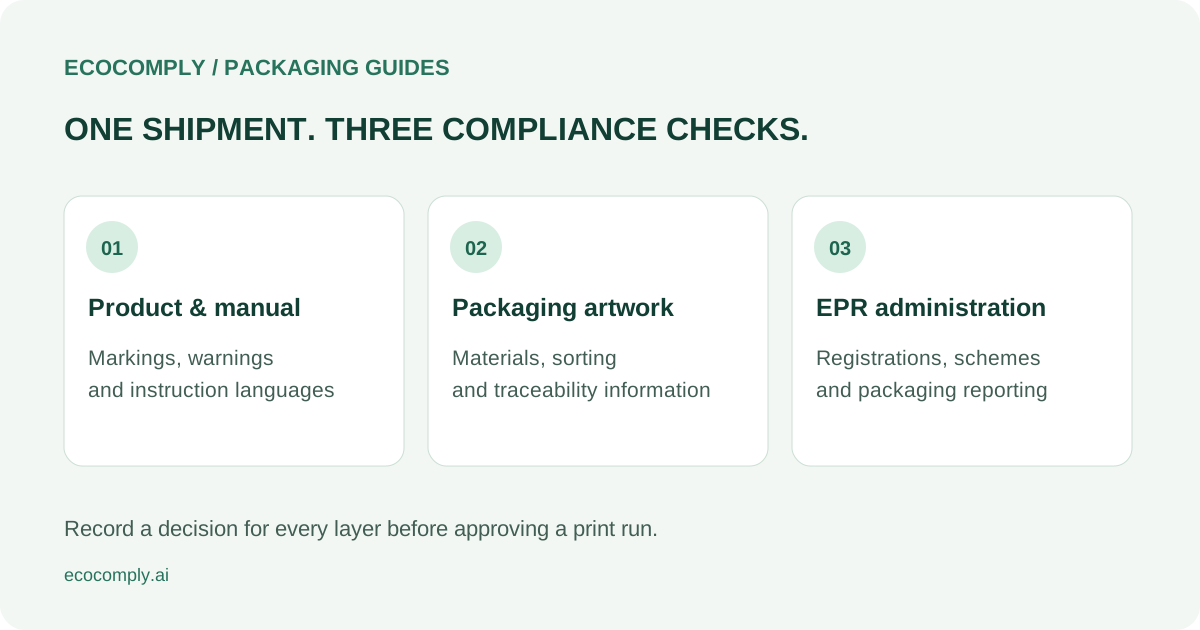
Table of Contents
TL;DR: You can often build one packaging design for several EU markets, but you must check each destination before printing. France uses Triman and Info-tri for relevant household packaging; Italy requires environmental labelling; Germany's LUCID registration is a separate EPR process. Product markings, safety instructions and packaging traceability need their own review. A recycling symbol does not replace registration, and registration does not approve your artwork.
Source check: 29 September 2026. Scope: ordinary non-food consumer-product packaging sold in France, Germany and Italy. This guide does not cover every EU country or the additional rules for food, chemicals, medicines, dangerous goods, deposit-return packaging or specialist product categories.
Can I use the same packaging across Europe?
Start with the same product and a destination matrix, rather than three disconnected artwork files. A shared carton can be practical if it accommodates the correct country instructions, product information and languages without becoming confusing or unreadable. Where it cannot, use controlled country versions.
There are three different questions to resolve: what the product needs, what its packaging needs, and which business must register and finance waste management. Give each question an owner. The designer should not have to infer legal roles from an EPR number.
One shipment, three separate checks
| Layer | What to check | Evidence to retain |
|---|---|---|
| 1. Product and manual | Applicable conformity markings, product identification, responsible business details, warnings and instruction languages. | Product assessment, approved label and manual versions. |
| 2. Packaging artwork | Packaging identification and contact information, country sorting instructions, material identification and legibility. | Material specifications, market matrix and final printer proof. |
| 3. EPR administration | Responsible producer, destination registrations, scheme participation and packaging reporting. | Registration confirmations, contracts and reported weights. |
Review framework: all three layers need a decision. Completing one does not complete the others.
Packaging labelling requirements by country
| Market | Packaging artwork focus | Separate administrative check |
|---|---|---|
| France | Applicable Triman and Info-tri instructions for household packaging, using the correct scheme artwork and exceptions. | French packaging EPR obligations and the responsible producer. |
| Germany | Applicable EU packaging and product information. Treat LUCID as registration, not an artwork approval or sorting label. | LUCID registration; system participation and volume reporting where applicable. |
| Italy | Material identification; consumer-facing waste collection information, with the permitted digital route assessed where relevant. | Italian packaging EPR obligations, assessed separately from environmental labelling. |
The following sections link to the national guidance behind this comparison. Do not use the table alone as a print specification.
France: Triman logo and Info-tri
The Triman identifies that sorting rules apply. Info-tri explains the relevant components and their sorting destinations. For an ordinary household packaging project, the practical task is therefore to build the correct combined information, not simply paste a Triman logo onto the carton. France's ministry explains how the two parts work together in its official Info-tri guidance.
Citeo provides the packaging artwork resources and distinguishes packaging types, including reuse arrangements. Check the scope and exceptions against its current packaging guidance. Product-stream labels—for example those associated with an electrical product—are a separate assessment from the label for its box.
For placement, small-pack conditions and the artwork workflow, use our Triman logo and Info-tri packaging guide.
Germany: LUCID registration is not a packaging label
The German packaging register's guidance separates registration from system participation and reporting. Registration is free. If the packaging is subject to system participation, registration alone is insufficient: a participation agreement and packaging-volume reports are also required.
For artwork review, keep that evidence in a separate column from the information printed on the packaging. A LUCID entry does not tell your designer whether product warnings, language versions or packaging traceability are complete. Nor should a voluntary recycling mark be treated as proof that the business has fulfilled its EPR duties.
Check the responsible producer against the current supply chain: direct selling, importing and distributing can create different responsibilities. Our Germany packaging EPR guide covers the registration workflow in more detail.
For overseas direct sellers: ZSVR states that a business based abroad selling empty packaging or packaged products directly to end users in Germany, without a German branch, must appoint an authorised representative for EPR. Check this when preparing the registration; it is separate from artwork approval. See the current LUCID registration guidance.
{{cta}}
Italy: material codes and collection information
Italy's environmental labelling framework is based on Article 219(5) of Legislative Decree 152/2006 and the guidance adopted by Ministerial Decree 360 of 28 September 2022. CONAI's environmental labelling platform is the practical starting point.
Distinguish material identification from disposal instructions. CONAI explains that material identification under Decision 97/129/EC applies to B2B and B2C packaging; packaging intended for consumers also needs the relevant collection information. Use supplier evidence to identify the material, rather than choosing a code by appearance. See CONAI's mandatory labelling guidelines and B2B material-identification guidance.
A digital channel can be part of the Italian environmental labelling approach. Follow CONAI's digital labelling manual: the consumer needs a clear route to the information. A generic homepage QR code is a poor substitute for an identifiable, maintained packaging-information page. Permission to provide environmental information digitally does not automatically extend to product safety warnings or manuals.
Transition: CONAI states that the current Italian environmental labelling format can be maintained through 11 August 2028. The harmonised EU labels follow the conditional Article 12 timetable explained below; check the implementing measures before preparing a later print run.
What belongs on the product label, packaging and manual?
Product labelling requirements depend on the product legislation. CE marking is required only for products covered by the relevant rules; it is not a general packaging recycling mark. The European Commission's product-compliance guidance also requires importers to check relevant instructions and safety information in a language understood by users in the destination country.
For a three-market launch, create a language and placement checklist for French, German and Italian requirements. Confirm the exact rules for your product before deciding whether a statement belongs on the device, box, accompanying document or online. Do not assume a multilingual outer carton cures an English-only safety manual, or that everything may move to a QR code.
This is the point to bring together the packaging designer, technical writer and compliance reviewer. Compare the product model name, business details and warnings across the artwork, manual and technical records before release. EcoComply's product documentation and labelling service supports this review.
What does PPWR change, and when?
Regulation (EU) 2025/40 generally applies from 12 August 2026, but its harmonised material-composition label follows a later timetable: Article 12(1) specifies 12 August 2028 or 24 months after the relevant implementing acts enter into force, whichever is later. The European Commission's PPWR guidance explains the transition from national to harmonised labels. Do not treat August 2026 as permission to remove current country information.
Also distinguish sorting labels from packaging traceability. Articles 15(5)–(7) cover a type, batch, serial number or another identifier, and the packaging manufacturer’s name, registered trade name or registered trademark, postal address and, where available, electronic means of contact. Article 18 also addresses importer details. Placement alternatives differ by obligation, so check each provision before choosing an on-pack, accompanying-document or digital route. Assess these duties for packaging placed on the market from the applicable date; do not assume that every existing stock item must be reprinted. The Swedish Environmental Protection Agency's explanation of the EU provisions sets out the distinction. Identify the packaging manufacturer under PPWR rather than automatically copying the product manufacturer's details.
Worked example: one boxed electronic accessory, three markets
Assume a non-EU brand sells an electronic accessory in a folding carton, with a removable plastic bag and a separate shipping box. This is a review example, not approved packaging artwork.
| Item in the shipment | Artwork decision | Supporting check |
|---|---|---|
| Electronic accessory | Confirm applicable product markings, identifiers and business details. | Product legislation and technical documentation. |
| Instruction leaflet | Prepare the required language versions and usable safety instructions. | Check against the actual device, intended use and foreseeable misuse. |
| Carton and removable bag | Map each component to the applicable French instructions and Italian material/collection information. | Obtain material specifications and check current scheme artwork. |
| Shipping box | Assess this packaging layer separately; do not assume the retail carton covers it. | Record who supplies it, where it becomes waste and its reporting weight. |
| Sales into each country | Release the correct market artwork version. | Confirm the responsible producer and relevant EPR arrangements. |
A workable artwork file might use a shared core plus clearly identified country information. Whether that fits depends on pack size, legibility and the approved label layouts. Keep the final decision in the specification so a later supplier cannot quietly replace the film or shrink the label.
Pre-print checklist for a multi-market launch
- List destinations and sales routes. Include marketplace orders and direct-to-consumer shipments.
- Inventory every packaging component. Record material, separability, dimensions, weight and supplier evidence.
- Separate legal roles. Identify the product manufacturer, packaging manufacturer, importer and EPR producer as applicable.
- Approve country information. Record the source and version used for each label.
- Check product labels and manuals together. Resolve inconsistent identifiers, warnings and languages.
- Check the physical proof. Inspect folds, seams, contrast and actual printed size; test any digital link.
- Confirm EPR readiness. Record registrations, participation and reporting responsibilities independently of the artwork.
- Control changes. Recheck the decision when materials, suppliers, markets or rules change.
Get the artwork and EPR workstreams aligned
Send EcoComply your packaging artwork, manual, product description and destination list. We can scope the label and manual review and identify the separate EPR registration and reporting work. If packaging is your only stream, see our PPWR packaging service. Return to the EPR resource hub for country and reporting guides.
Sources and review notes
Sources checked on 29 September 2026. This article distinguishes legislation, regulator guidance and scheme implementation resources. Recheck the destination rules and PPWR implementing measures before approving a new print run.
- Regulation (EU) 2025/40: Articles 12, 15 and 18.
- Commission Notice C/2026/3084: PPWR guidance, including labelling transition.
- French Ministry: understanding Info-tri and Citeo packaging resources.
- ZSVR: LUCID registration, participation and reporting.
- CONAI environmental labelling platform, mandatory guidelines and digital-channel manual linked above.
- European Commission: general product compliance.
Frequently Asked Questions
Everything you need to know about EU compliance
Often, provided the artwork meets the applicable requirements in each destination and remains legible. Check country sorting information, product warnings, languages and packaging traceability before approving a shared design.
No. Keep registration and reporting evidence separate from the artwork approval. Both workstreams need to be checked for your product, packaging and destinations.
No. Digital alternatives depend on the specific obligation and its conditions. Permission to provide environmental information digitally does not automatically cover product safety warnings or instructions.

Check your packaging before it goes to print
Send your artwork, manual and destination list. We can scope the label review and the separate EPR registration work.
Launch in the EU without compliance guesswork
Get a clear view of what documents you need, what’s missing, and how to avoid market access blockers, built for electronics & IoT manufacturers.
- Identify missing CE deliverables (DoC, test reports, technical file)
- Plausibility checks aligned with market surveillance expectations
- Expert validation for edge cases