

XLSX
Free resource · XLSX / CSV / PDF
Wireless Module Integration Evidence Matrix: what your radio module's CE evidence still covers
See what your radio module’s CE evidence still covers—and where your finished product needs review.
No email required
One pack. Three useful formats.
What’s included
Five tabs: instructions, a blank template with a product record and 16 starter rows, a blank evidence register, a worked example and a reference list of primary sources.
The same columns and starter rows, for your own tools.
The method, the starter rows by topic, the worked example, the standards points that change outcomes and the cybersecurity timeline.
Module identity and integration conditions, radio spectrum (EN 300 328), EMC of the finished device (EN 301 489-1/-17), safety and batteries, RF exposure, RED cybersecurity and the Cyber Resilience Act, the conformity-assessment route, technical documentation and DoC, instructions and marking, RoHS, co-location of several radios and change control.
Explore the guide
Is this for my product?
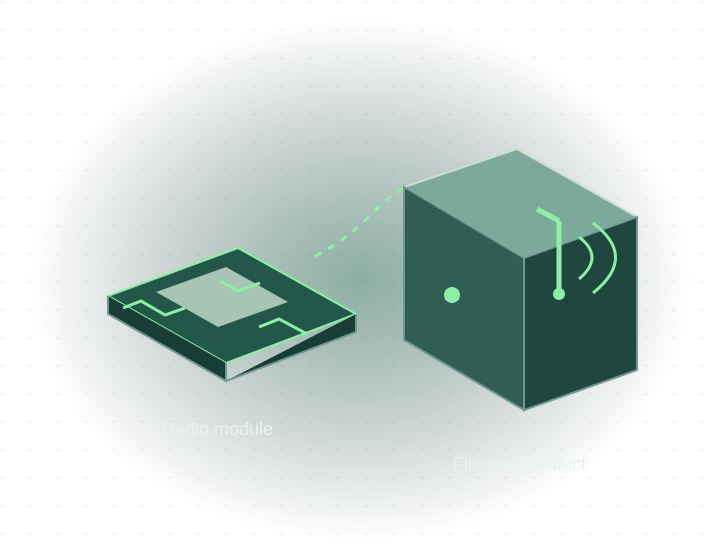
A pre-certified Bluetooth, Wi-Fi or LoRa module saves you RF work, but its EU declaration of conformity is about the module, and only under the conditions in the supplier’s integration instructions. Once it is on your board, near your regulator and inside your enclosure, whoever places the finished product on the market is its manufacturer under the Radio Equipment Directive (RED) and must demonstrate conformity of the whole device.
The Wireless Module Integration Evidence Matrix is a free workbook for making that call row by row. For each RED requirement and the adjacent legislation (RoHS, batteries, the Cyber Resilience Act), it records which supplier conditions your design keeps, which it changes, and what follows. A fictional BLE environmental monitor shows a completed review.
BUILT FOR YOUR TEAM
Teams placing a finished product with a pre-certified Bluetooth, Wi-Fi or LoRa module on the EU market, who must demonstrate conformity of the whole device under the Radio Equipment Directive.
The worked example follows a fictional battery-powered BLE environmental monitor that reports to a separate gateway.
How to use the workbook
Check module identity
Compare the module model, its hardware revision and the stack version on your BOM with the ones on the supplier’s DoC and reports.
List the supplier’s conditions
Approved antennas and maximum gain, keep-out from metal, supply range and ripple, grounding and RF power settings each become a comparison.
Compare with your release design
Antenna surroundings, enclosure, battery, regulator and ground plane, ports and cables, firmware, other radios and installation distance.
Decide each row
Start the conclusion with justified reuse, documentation-only correction, material gap or evidence missing. If a pre-scan will decide, write the pass criterion down before measuring.
Record the assessment route
Self-assessment is only available where harmonised standards are applied in full and no listed restriction applies; otherwise a notified body is involved.
Keep it under change control
A module revision, antenna, enclosure, regulator or firmware change re-opens the affected rows.
See the worked example
FICTIONAL WORKED EXAMPLE
The fictional EX-ENV-20 is a wall-mounted, battery-powered sensor with a BLE module and PCB trace antenna, a switching regulator, USB-C charging and a plastic enclosure on a metal mounting plate. It reports to a separate gateway.
The supplier asks for at least 10 mm between the antenna and metal; the mounting plate sits at 4 mm. That is a material gap: the detuning effect cannot be bounded on paper, so the review sets a pass criterion and books a radiated pre-scan with the enclosure and battery fitted. A switching regulator placed 8 mm from the module, with the ground plane split beneath it, is a second material gap. The BOM carries a newer module revision than the supplier’s DoC, there is no whole-product EMC test with the USB-C port, and battery evidence exists only at cell level: all evidence missing. The RF exposure assessment needs only a calculation and a mounting-distance line in the instructions, a documentation-only correction. Whether the sensor falls under RED cybersecurity because it reaches the internet through the gateway stays an open scope decision until the architecture is documented.
Frequently asked questions
Does a CE-marked radio module make my product CE compliant?
No. The module’s declaration covers the module as supplied and under its integration conditions. The finished product needs its own technical documentation and EU declaration of conformity. Supplier radio-spectrum evidence can often be reused if you keep the integration conditions; EMC, safety, RF exposure and cybersecurity are assessed for the finished product.
When can I reuse the module supplier’s RED test reports?
When the conditions the supplier’s assessment depended on are preserved in your design: same module revision and firmware, an approved antenna within the stated gain, the required keep-out and a supply within specification. For combined and multi-radio equipment, ETSI EG 203 367 explains when earlier assessments can be carried over. Record the conditions in your file so reuse stays valid only while they hold.
Which EMC standard applies to a Bluetooth or Wi-Fi product under the RED?
For 2.4 GHz wideband equipment, EN 301 489-17 together with EN 301 489-1. EN 301 489-17 V3.3.1 is the edition cited in the Official Journal (since May 2025, with notices). Check the current RED summary list at your placing-on-market date.
Does RED cybersecurity apply to a BLE sensor that only talks to a gateway?
Possibly. Delegated Regulation (EU) 2022/30 covers radio equipment that can communicate over the internet directly or through other equipment, so whether a gateway-connected sensor is in scope has to be decided and written down; it is not exempt by default. Delegated Regulation (EU) 2026/339 repeals those RED requirements from 11 December 2027, the date of full application of the Cyber Resilience Act. CRA reporting obligations already apply from 11 September 2026.
Do I need a notified body for EN 18031?
Only in some cases. The EN 18031 series is cited in the Official Journal with restrictions. Where a restriction applies to your product, the standard does not give presumption of conformity for that part and a notified body is needed for the cybersecurity requirements.
Related reading
Supplier CE test reports: how to judge what a supplier’s report actually covers.
Component Change Review for Electronics: a free guide to deciding whether a part change invalidates your existing evidence.
From EcoComply
EcoComply GmbH helps electronics manufacturers identify evidence gaps, prepare product compliance documentation and coordinate testing for the EU market. Need help applying this resource to your product?
Review status & disclaimer
The Wireless Module Integration Evidence Matrix is a review record, not a conformity determination. The worked example is fictional; no measurements, test results or approvals are asserted. Standard editions, citations and notices must be re-checked at the date you place the product on the market. This resource is not legal advice.
Version 1.0 · Last updated 27 November 2026 · Corrections: john@ecocomply.ai