

XLSX
Free resource · XLSX / CSV / PDF
CE Technical File Evidence Map: a template that ties every requirement to its evidence
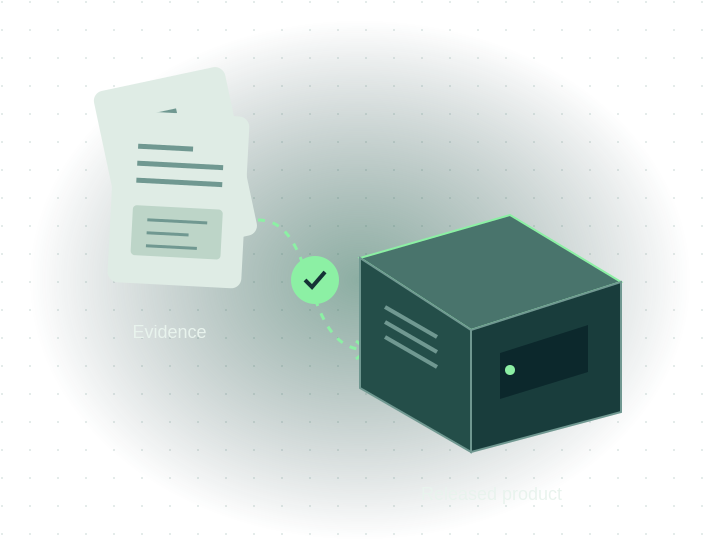
Connect each requirement to its evidence, tested configuration and the product you actually ship.
No email required
One pack. Three useful formats.
What’s included
Five tabs: instructions, a blank template with a product record and 15 starter rows, a blank evidence register, a worked example and a reference list of primary sources.
The same columns and starter rows, for import into your own PLM, QMS or spreadsheet tool.
The method, four outcome labels, the worked example and the dates to keep in view.
Each starter row names its legal basis and the relevant standard, for example EMC Annex II point 2 for the risk assessment or EN IEC 63000:2018 for RoHS documentation. The columns cover applicability, assessed versus released baseline, evidence IDs, the gap, the standard edition and its Official Journal status, the technical conclusion, owner, due date and reviewer.
Explore the guide
Is this for my product?
A CE technical file is more than an EMC report, some supplier certificates and an unsigned declaration. Someone other than the test engineer should be able to open it and see, for each requirement, which document covers it, which configuration that document actually describes, and why that is enough for the product you ship.
The CE Technical File Evidence Map is a free workbook for doing exactly that. It is built for wired electrical and electronic equipment under the EMC Directive and RoHS, and it also prompts you to screen the Cyber Resilience Act, the Machinery Regulation, WEEE, REACH and packaging. A fictional 24 V DC industrial controller shows how a completed review looks.
BUILT FOR YOUR TEAM
Engineering, quality and compliance teams preparing or reviewing the CE technical file for wired electrical and electronic equipment under the EMC Directive and RoHS.
The workbook also prompts you to screen the Cyber Resilience Act, the Machinery Regulation, WEEE, REACH and packaging.
How to use the workbook
Fill in the product record
Write down the tested sample exactly as the reports describe it and the configuration you will release: hardware revision, firmware, BOM, harness and accessories.
Decide which rows apply
Give each starter row a one-line rationale. Mark rows that do not apply instead of deleting them, so the reasoning stays in the file.
Register your evidence
Give each report, declaration, drawing and memo an ID, and record the configuration and standard edition it covers.
Compare and conclude
For each row, state what was tested, what ships and the difference, then start the conclusion with one of four labels: justified reuse, documentation-only correction, material gap or evidence missing.
Assign and close
Put an owner and a due date on every open action. Sign the EU declaration of conformity only when the rows it depends on are closed.
Re-open on change
A new BOM, firmware build, harness, supplier or standard edition sends you back to the affected rows.
See the worked example
FICTIONAL WORKED EXAMPLE
The example product is fictional: an industrial controller with a 24 V DC input, Ethernet and a 5 m sensor harness, no radio and no mains adapter. The EMC report on file was made on an earlier hardware revision in idle mode with a 1 m cable.
The review separates three kinds of finding. Emissions and immunity are material gaps: the shipped harness length and Ethernet traffic were never tested, and ports with cables over 3 m need tests that were not run. The missing standard edition on the report cover and the outdated firmware on the draft declaration are documentation-only corrections. Missing declarations for three substituted parts and the absent vulnerability-handling process under the Cyber Resilience Act are evidence missing. The scope row records why the Low Voltage Directive does not apply (24 V DC is below the 75 V DC lower limit) and why safety still needs its own assessment.
Frequently asked questions
What is a CE technical file?
It is the documentation a manufacturer keeps to show that a product meets the EU legislation that applies to it: product description, design and manufacturing information, the risk assessment, the standards applied, test reports and other evidence, and the EU declaration of conformity. Under the EMC Directive you keep it for 10 years after placing on the market and hand it to market surveillance authorities on request.
Is a passing EMC test report enough for CE marking?
No. A report covers the sample, firmware, cables and operating mode the laboratory tested, against one edition of a standard. The manufacturer must still demonstrate that the released product matches that configuration, or why the differences do not matter, and cover the other legislation that applies, such as RoHS and, for connected products, the Cyber Resilience Act.
How do I know which edition of a harmonised standard to cite?
Check the Commission’s summary list of harmonised standards for the directive at your placing-on-market date, not the report cover. A standard body’s withdrawal date is not the same as a withdrawal in the Official Journal. For example, the EMC list still cites EN 61326-1:2013, not the 2021 edition.
Does a 24 V DC product need to meet the Low Voltage Directive?
The Low Voltage Directive covers equipment rated from 75 V DC (50 V AC). A product rated only at 24 V DC, with no mains adapter supplied, is usually outside its scope, but you must check every rated input and output and any supplied accessories. Being outside the LVD does not remove the need to show the product is safe.
Is this template a conformity assessment?
No. The map is a review record, not a conformity determination. It records the evidence and reasoning your competent reviewer relies on; the manufacturer remains responsible for the decision.
Related reading
Technical documentation for CE marking: what the file must contain and how long to keep it.
Component Change Review for Electronics: a free guide to deciding whether a part change invalidates your existing evidence.
From EcoComply
EcoComply GmbH helps electronics manufacturers identify evidence gaps, prepare product compliance documentation and coordinate testing for the EU market. Need help applying this resource to your product?
Review status & disclaimer
The CE Technical File Evidence Map is a review record, not a conformity determination. The worked example is fictional; no test results or approvals are asserted. Standard editions and Official Journal statuses must be re-checked at the date you place the product on the market. This resource is not legal advice.
Version 1.0 · Last updated 27 November 2026 · Corrections: john@ecocomply.ai