KKDIK (Turkish REACH) Update 2025: e-CBS SDS Rules
KKDIK (Türkiye REACH) compliance is tightening in 2025: new procedures require accurate e-CBS submissions, updated SDS formats (Annex 2), and joint registration practices (“One Substance–One Registration”). This briefing also covers India’s machinery safety order (mandatory Sept 2026) and the EU’s New Legislative Framework revision (digital CE, DPP, market surveillance).
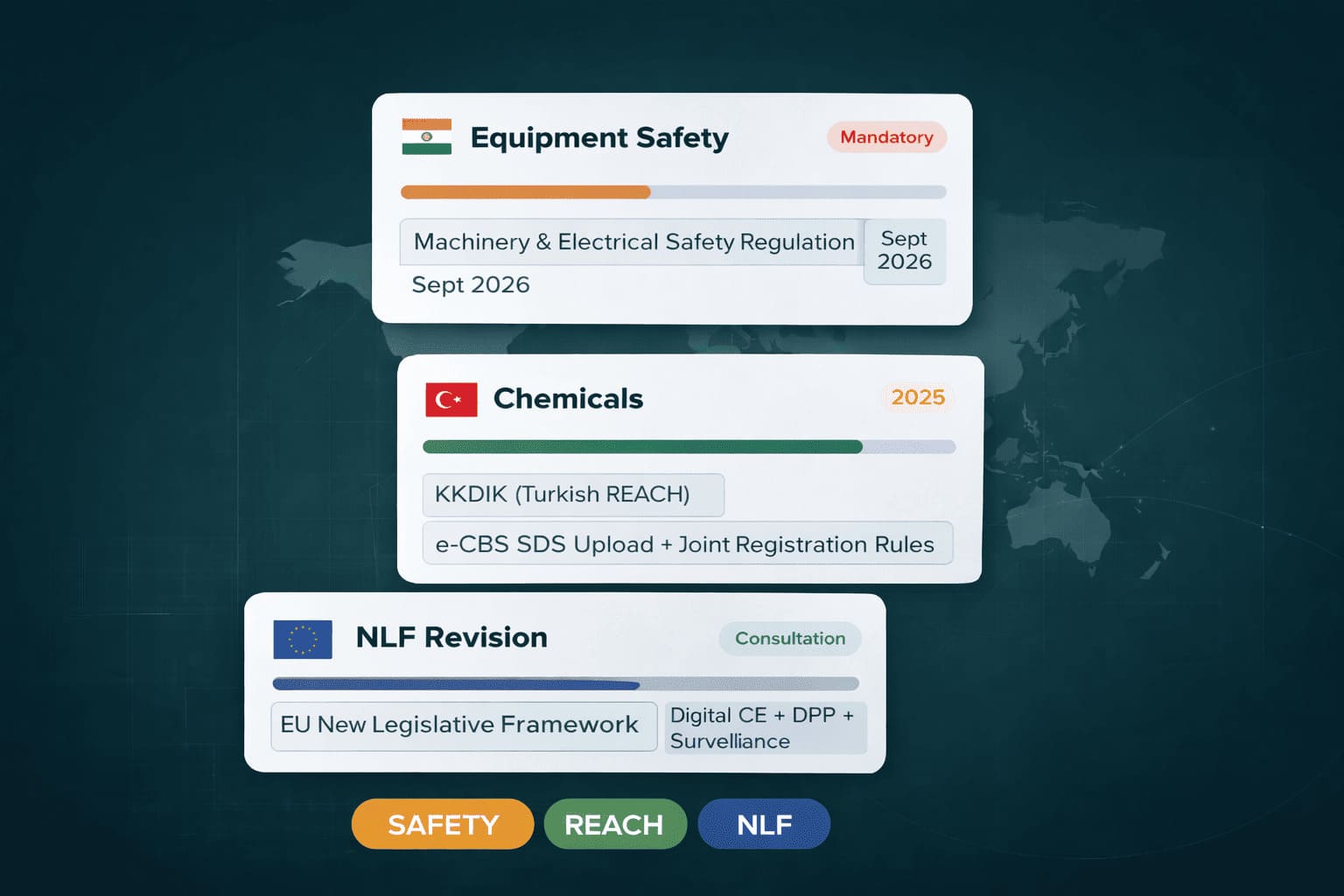
Table of Contents
New safety mandates, chemical rules, and product framework updates are redefining regulatory strategies across key markets. Here's what’s changing - and how to stay compliant.
🇮🇳 India Machinery & Electrical Equipment Safety Regulation (Mandatory Sept 2026)
The "Machinery and Electrical Equipment Safety (Omnibus Technical Regulation) Order" requires that the manufacture, import, and sale of machinery and electrical equipment meet national and international safety standards.
It defines machinery categories, applicable technical standards, and conformity assessment processes. The regulation emphasizes essential safety principles from IS 16819:2018 and ISO 12100:2010, as well as additional Type B and Type C standards. Initially issued in 2024 and amended in 2025, the mandatory implementation date is set for September 1, 2026.
Statut: In effect for Compressors, Centrifuges and filtering machines, Cranes, Construction and mining machinery, Electrical machinery, Switchgear, motor starters, converters, Textile machinery, Metal cutting, processing machines and machine tools, Industrial packaging and plastic processing equipment.
📌 What This Means for Manufacturers
- Prepare conformity documentation early - assess alignment with IS 16819:2018 and ISO 12100:2010, especially for multi-market SKUs.
- Coordinate internal ownership between engineering, safety, and regulatory affairs to prevent September 2026 noncompliance risks.
- Audit high-risk machinery categories for gaps in hazard prevention measures and emergency protocols now.
🇹🇷 KKDIK (Turkish REACH) 2025: e-CBS SDS Upload + Joint Registration Rules
The procedures for the Regulation on the Registration, Evaluation, Authorization, and Restriction of Chemicals in Türkiye (KKDIK or Turkish REACH) were published on August 5, 2025.
These rules outline the registration, evaluation, authorization, and restriction of chemical substances and mixtures in Turkey. All chemicals manufactured or imported in quantities of 1 ton or more per year must comply with the "One Substance-One Registration" principle and the Joint Registration Group principle.
Up-to-date safety data sheets must be uploaded to the Ministry via the electronic system (e-CBS), including the certificate and contact information of the preparing chemist in Annex 2.
Statut: Active enforcement applies to all product groups subject to the REACH regulation that trade with Türkiye.
📌 What This Means for Manufacturers
- Assign internal responsibility to local regulatory experts for e-CBS portal submissions - compliance hinges on digital accuracy.
- Join or initiate a Joint Registration Group (JRG) to avoid registration bottlenecks or duplicative costs.
- Ensure all SDSs meet new format and Annex 2 requirements - outdated formats may trigger enforcement actions.
{{cta}}
🇪🇺 EU New Legislative Framework (NLF) Revision: Digital CE + DPP + Surveillance
The NLF serves as the legal foundation for harmonized product legislation in the EU. It establishes essential requirements, conformity assessment processes, CE marking guidelines, and market surveillance rules.
The framework includes Regulation (EC) No 765/2008 and Decision No 768/2008/EC. Current revisions aim to integrate digital product passports, digital CE marking, remanufacturing, and high-quality recycling to support sustainability and digitalization.
Stronger compliance and market surveillance throughout the product lifecycle are also emphasized.
Statut: Active enforcement - the EU’s product framework must evolve to meet new sustainability and digital trade standards.
📌 What This Means for Manufacturers
- Prepare to integrate digital product passports into compliance workflows — pilot programs should begin in 2025.
- Reevaluate remanufactured product strategies in light of stricter traceability and CE marking expectations.
- Monitor updates to EU harmonized standards — market access could be affected if surveillance flags non-conformities.
✅ Need help aligning with these global regulatory shifts?EcoComply delivers real-time compliance tracking and task automation for product teams.
Frequently Asked Questions
Everything you need to know about EU compliance

Selling into more than one of these markets?
India, Türkiye and the EU each moved separately this year. A declaration that was correct at launch quietly stops being correct, and nobody tells you. We map what actually applies to your product, in every market you sell in, within 48 hours.
- Every applicable directive, regulation and scheme identified
- Gaps in your existing documentation flagged, with what it costs to close them
- Ongoing monitoring so superseded standards don't go unnoticed
Launch in the EU without compliance guesswork
Get a clear view of what documents you need, what’s missing, and how to avoid market access blockers, built for electronics & IoT manufacturers.
- Identify missing CE deliverables (DoC, test reports, technical file)
- Plausibility checks aligned with market surveillance expectations
- Expert validation for edge cases