EU Styrene Migration Limit: Food-Contact Compliance Update
EU food-contact compliance is changing: the Commission is setting a styrene Specific Migration Limit (SML) of 40 µg/kg under the EU Plastics Regulation (EU) No 10/2011 (Amendment 18). This briefing also covers New Zealand’s upcoming smart EV charger requirements (earliest 2026) and the EU’s review of Standardisation Regulation 1025/2012 (proposal expected 2026).
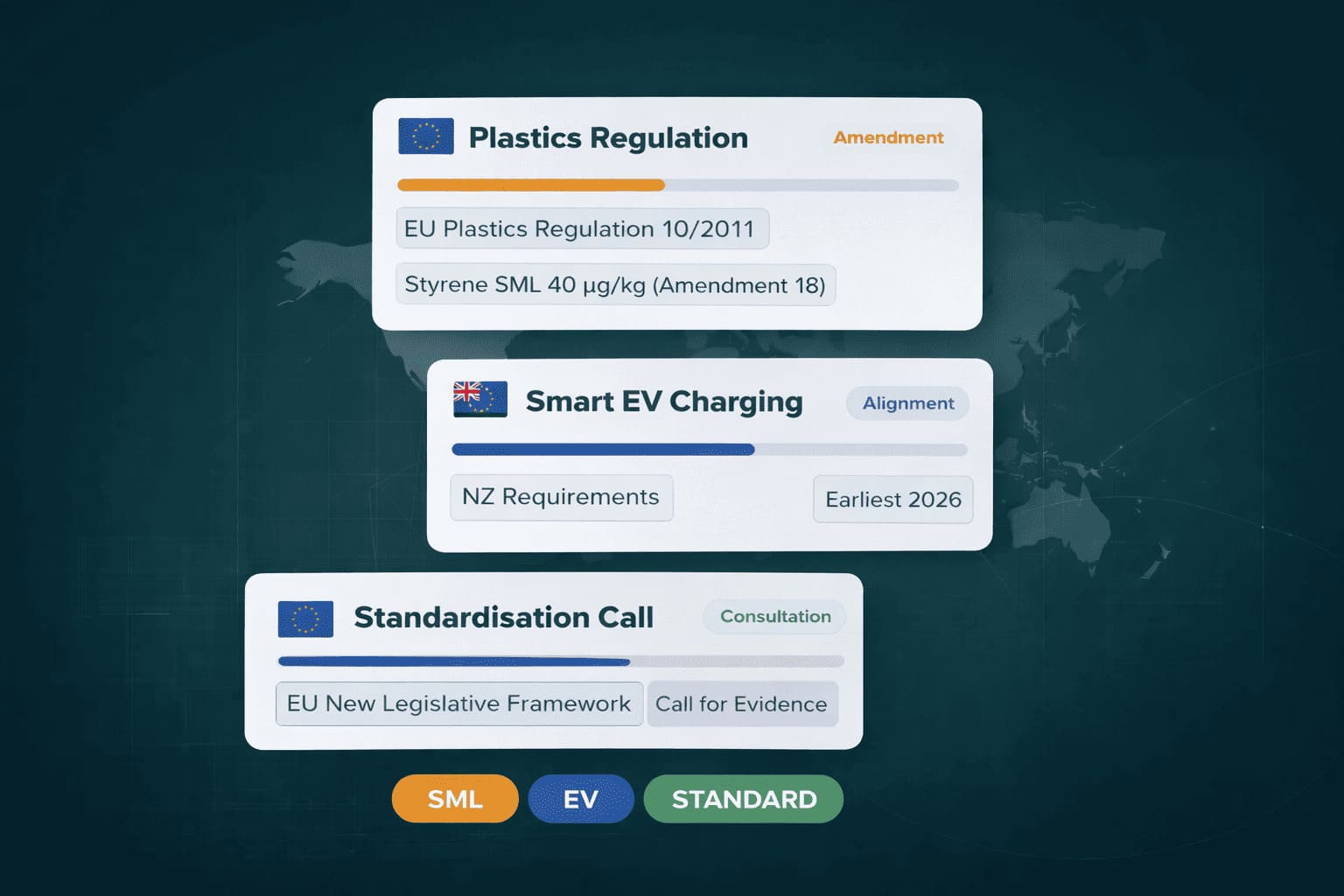
Table of Contents
At EcoComply, we help manufacturers stay ahead of global regulations - translating complex compliance laws into clear, actionable tasks. Our platform delivers real-time alerts, task tracking, and AI-powered insights so you can reduce risk and speed up certification workflows. Drop us an email at hello@ecocomply.ai for a demo!
Three regulatory updates—across materials, energy infrastructure, and product standards—signal key shifts for manufacturers navigating EU and APAC markets.
🇪🇺 EU Plastics Regulation 10/2011: Styrene SML 40 µg/kg (Amendment 18)
The European Commission is preparing a regulation to set an SML for styrene at 40 micrograms/kg of food (40 ppb).
This value was determined in light of the protection of human health and available scientific data. In its updated scientific assessment in 2025, EFSA (European Food Safety Authority) stated that oral exposure to styrene does not pose a genotoxic risk and emphasized that setting the SML at 40 µg/kg of food does not pose a health risk.
The SML limit is expected to be added to the EU Plastics Regulation (EU) No 10/2011 as the 18th amendment (in 2025).
The public and stakeholder consultation period has been completed, and the new regulation is expected to take effect soon.
Statut: In effect - If the electrical/electronic product itself or its components are used as food contact surfaces/bodies, storage containers, or similar purposes (e.g., small household appliances with polystyrene/plastic bodies used in kitchens, yogurt makers, etc.).
If electrical kitchen appliances (such as blenders, yogurt makers, mixer bowls, ayran makers, hot air oven plates, etc.) made of styrene-containing polymers, such as ABS, SAN, HIPS, or PS, are in direct contact with food.
📌 What This Means for Manufacturers
- Immediately review product portfolios and BOMs for styrene-based polymers in direct food-contact components.
- Update Declarations of Conformity (DoC) and supplier verification for affected SKUs.
- Coordinate with QA/RA teams to ensure labeling and materials testing align with (EU) No 10/2011 Amendment 18.
🇳🇿 New Zealand Smart EV Charging Requirements (Earliest 2026)
The goal is to require that electric vehicle chargers sold in New Zealand are designed to meet specific "smart requirements."
This means that these chargers must adhere to certain connectivity and energy efficiency standards and include technological features that facilitate demand management and optimize energy usage.
Key requirements include:
- Remote Control and Communication: Chargers must be capable of connecting to centralized software systems, enabling grid operators to remotely manage and monitor the charging process.
- Time-of-Use Charging: Smart chargers should automatically adjust their charging schedule based on electricity prices or grid demand. This includes the ability to delay or modify charging during peak demand periods.
- Cybersecurity: Given that these devices are smart, they must have encrypted data communication to secure all interactions between the device and external systems. Additionally, chargers should include hardware protections to prevent fraud or tampering, as well as regular security updates to enhance protection.
Statut: Active enforcement. The proposed policy option (if progressed) will come into force in New Zealand regulation no earlier than 2026.
📌 What This Means for Manufacturers
- Start incorporating demand-response and secure communications architecture into product development.
- Engage now with NZ regulatory bodies or local agents to shape pre-implementation requirements.
- Prepare for conformance testing and documentation aligned with the earliest likely 2026 enforcement.
🇪🇺 The Call for Evidence on Standardisation Regulation 1025/2012/EU
The evaluation of how well the legislation aligns with current needs and technological advancements was conducted through assessments initiated in 2023 and through public and stakeholder consultations held in the summer of 2024.
According to the roadmap published by the EU Commission at the beginning of 2025, the goals of updating the regulation are to accelerate the standardization process and make it more accessible; strengthen Europe’s role in setting standards amid international geopolitical competition; and ensure the protection of European values and the EU’s economic interests.
Statut: In effect - It is expected that this regulation, which will affect all products, will undergo public consultation in the second quarter of 2025, followed by the publication of a concrete legislative proposal in the second quarter of 2026.
📌 What This Means for Manufacturers
- Track how revisions may impact harmonized standard timelines and EU conformity paths.
- Review internal processes that rely on slow standard updates or approvals—speed may become a competitive factor.
- Assign regulatory intelligence teams to monitor consultation phases and prepare position statements.
Frequently Asked Questions
Everything you need to know about EU compliance

Launch in the EU without compliance guesswork
Get a clear view of what documents you need, what’s missing, and how to avoid market access blockers, built for electronics & IoT manufacturers.
- Identify missing CE deliverables (DoC, test reports, technical file)
- Plausibility checks aligned with market surveillance expectations
- Expert validation for edge cases