EU Battery Regulation Implementing Rules: 2026 Checklist
EU Battery Regulation (2023/1542) implementing rules enter into force 20 April 2026, defining digital reporting and registration formats—plus GPSR safety/recall guidance and Albania cybersecurity certification alignment.
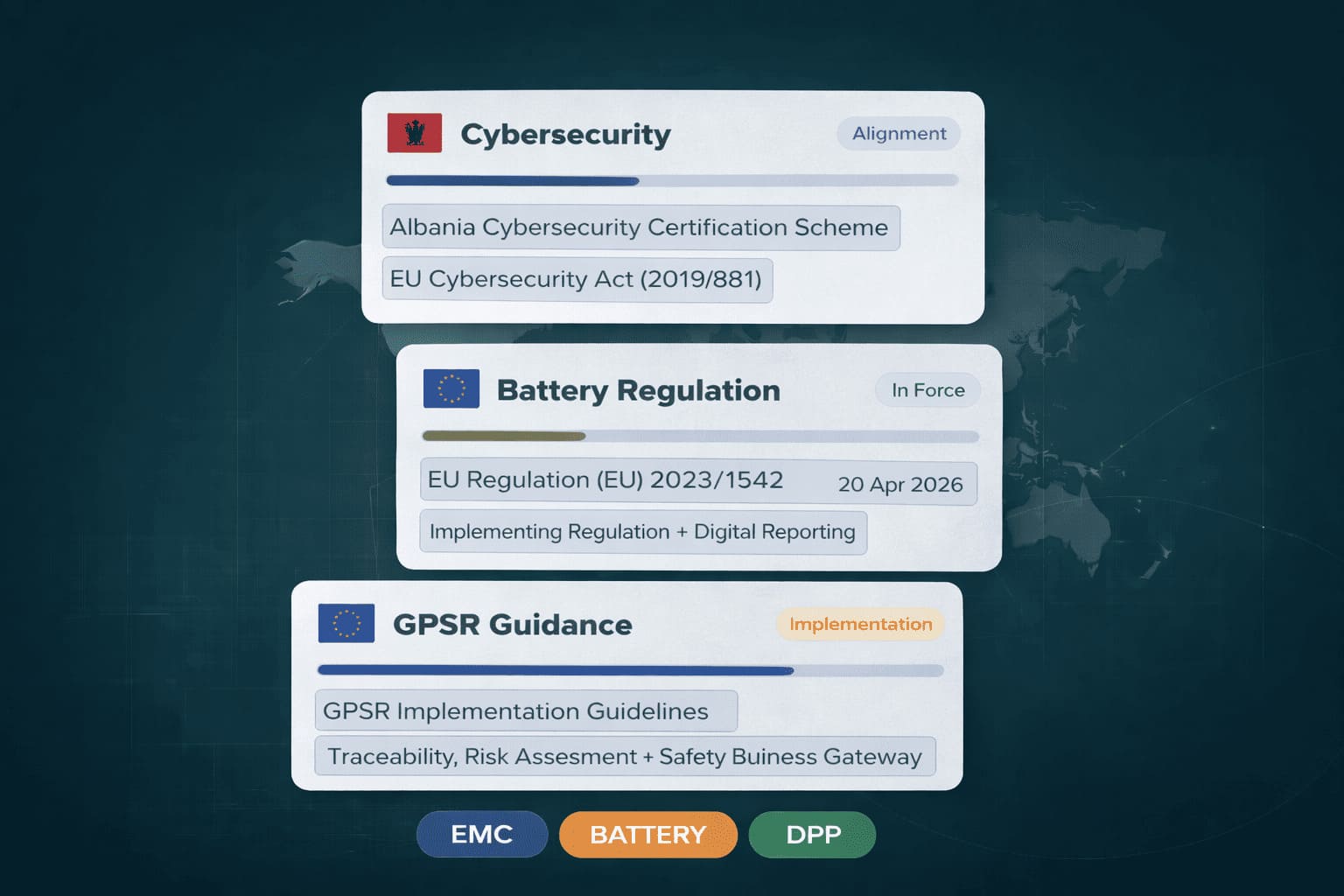
Table of Contents
Manufacturers operating in Europe and its neighboring regions face three new regulatory developments affecting product data, certification pathways, and safety obligations. Here’s what changed—and what you need to do.
🇦🇱 Albania Cybersecurity Certification Scheme: Alignment with EU Cybersecurity Act (2019/881)
Draft Decision on Approving the National Cybersecurity Certification Scheme and its Security Levels in Albania
This is a national implementation step aimed at aligning with the EU cybersecurity and certification framework. Since Albania is not an EU member, it cannot directly implement EU regulations; therefore, it must establish its own national certification scheme by a Council of Ministers decision to comply with the EU Cybersecurity Act and NIS2.
It is stated that this scheme is linked to the rules under the EU cybersecurity certification framework and Regulation (EU) 2019/881 (Cybersecurity Act); that is, it aims for alignment with the EU Cybersecurity Certification Framework in terms of logic and structure. Balkan countries closely follow EU regulations, and there may be additional expectations regarding alignment, such as which institution will issue certificates and which testing laboratories will be authorized.
Statut: Active enforcement – The draft will be open for comments until the end of February. All manufacturers and importers who deploy products that exchange data and connect to Wi-Fi in Albania should closely follow this issue.
📌 What This Means for Manufacturers
- Determine if any of your connected devices are sold or distributed in Albania; certification may soon be mandatory.
- Anticipate future market access barriers if alignment with EU schemes is incomplete or delayed.
- Engage with local legal advisors to track which institutions are designated to issue certifications or conduct tests.
🇪🇺 EU Battery Regulation (EU) 2023/1542: Implementing Regulation + Digital Reporting (In Force 20 Apr 2026)
Draft Commission Implementing Regulation laying down rules for the application of Regulation (EU) 2023/1542 (Battery Regulation)
The draft decision is a detailed explanation of how the Battery Regulation (Regulation (EU) 2023/1542) will be implemented. It clarifies at a technical level how manufacturers, importers, distributors, and authorized representatives will fulfill their specific obligations (e.g., providing information, making declarations, registering, reporting) under Regulation 2023/1542.
This draft will be one of the framework documents that will concretely determine in what format technical/chemical/performance/recycling data should be submitted and in which IT systems registration is required.
Statut: In effect – The entry into force date is 20 April 2026. All categories of batteries, including those embedded in products, are covered.
📌 What This Means for Manufacturers
- Standardize data submission formats now; delays in system integration may lead to noncompliance.
- Review internal compliance systems for traceability, testing, and lifecycle reporting of all battery types.
- Appoint a regulatory lead to oversee adaptation to the new digital reporting frameworks and system registrations.
🇪🇺 GPSR Implementation Guidelines: Traceability, Risk Assessment + Safety Business Gateway
Guidelines have been published for businesses to implement the GPSR Regulation
The EU Commission’s new GPSR document package significantly concretizes the framework with implementation guidance for businesses on the general safety of consumer products, a practical guide for the Safety Business Gateway, and a general set of FAQs. The focus is on clarifying the responsibilities of manufacturers/importers/distributors/online marketplaces, the definition of a “safe product,” risk assessment, labeling/traceability, and recall processes according to the GPSR logic.
Statut: Active enforcement – All changes related to GPSR will affect all products bearing the CE marking. Importers and online sellers should implement the guidelines without delay.
📌 What This Means for Manufacturers
- Ensure labeling now reflects GPSR traceability codes, batch IDs, and multilingual safety instructions.
- Implement a system for logging complaints, software vulnerabilities, and incident-related corrective actions.
- Update distributor contracts and ecommerce compliance workflows to meet GPSR obligations.
✅ Ready to integrate these changes into your compliance workflow?
EcoComply’s AI-powered compliance automation platform delivers real-time alerts, data tracking, and built-in guidance for upcoming EU and partner-country regulations.
Frequently Asked Questions
Everything you need to know about EU compliance

Launch in the EU without compliance guesswork
Get a clear view of what documents you need, what’s missing, and how to avoid market access blockers, built for electronics & IoT manufacturers.
- Identify missing CE deliverables (DoC, test reports, technical file)
- Plausibility checks aligned with market surveillance expectations
- Expert validation for edge cases