EU Circular Economy Act (2025): Compliance Updates
The EU Circular Economy Act consultation closed on 6 November 2025 and the Commission's legislative proposal is now expected on 11 November 2026, setting the rules for secondary raw materials and circular design. This update is paired with enforcement moves in Egypt (ES 8604-2 for EV charging cables, now compulsory) and Israel (SI 60335 Part 2.27 declared mandatory for skin-exposing devices).
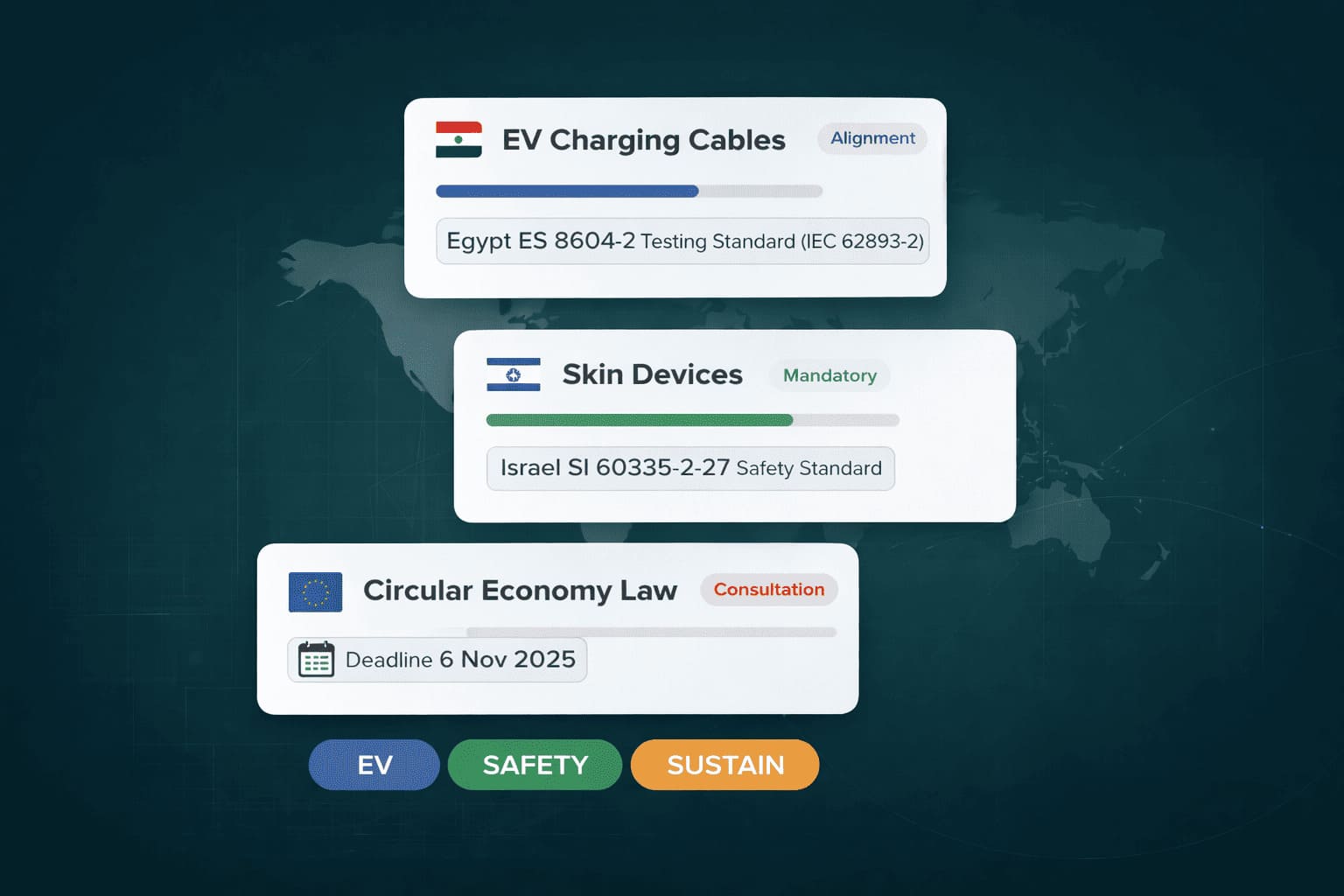
Table of Contents
The EU consultation and the Israeli comment window have both closed, and Egypt's ES 8604-2 is now compulsory under Ministerial Decision No. 245 of 2025. Dates and statuses below reflect the position at that date.
A trio of policy shifts across Egypt, Israel, and the European Union are now reshaping the regulatory landscape for electronics, energy, and sustainability. Here’s what’s happening and what your compliance team needs to do next.
🇪🇬 Egypt ES 8604-2: EV Charging Cable Testing Standard (IEC 62893-2)
Original Regulation:
This Egyptian Standard ES: 8604-2 outlines the test methods for electrical cables with extruded insulation and sheathing, having a rated voltage of up to 0.6/1 kV (AC) or up to 1500 V DC.
These cables are intended for flexible applications under extreme power supply conditions, specifically between the power supply point or charging station and the Electric Vehicle (EV).
ES 8604-2/2025 is technically identical to IEC 62893-2:2017. It was notified to the WTO as G/TBT/N/EGY/498 on 18 December 2024 and has since been made compulsory by Egyptian Ministerial Decision No. 245 of 2025, which gives producers and importers a one-year transitional period. Amendments to Egyptian standards continue to be announced through administrative orders published in the Official Gazette.
Status: Compulsory — one-year transition running
Ministerial Decision No. 245 of 2025 made ES 8604-2 compulsory and set a one-year transitional period running from the date of the decision. All manufacturers placing EV charging cables on the Egyptian market must comply by the end of that period.
📌 What This Means for Manufacturers
- Audit existing AC/DC cable stock and designs intended for Egyptian markets to ensure they meet ES 8604-2 specifications.
- Align testing and certification procedures with IEC 62893-2:2017, as technical equivalence is recognised.
- Assign local regulatory liaison to monitor future changes via the Egyptian Official Gazette.
{{cta}}
🇮🇱 Israel SI 60335-2-27: Mandatory Safety Standard for Skin-Exposing Devices
Original Regulation:
All requirements of the current Israel Standard, SI 60335 Part 2.27, which pertains to electrical appliances that expose the skin to optical radiation, shall be considered mandatory.
This declaration supports the goal of compulsory standardisation aimed at protecting public health. SI 60335 Part 2.27 adopts IEC 60335-2-27 Edition 6.0 (2019-05), with national deviations set out in the Hebrew section of the standard. Note that IEC has since published Edition 7.0 (2024), so the Israeli standard still references the earlier edition. The comment period on the mandatory declaration closed on 9 November 2025.
Status: Declared mandatory — comment period closed 9 November 2025
Manufacturers of appliances that expose the skin to optical radiation must meet the full requirements of SI 60335 Part 2.27, including the Israeli national deviations.
📌 What This Means for Manufacturers
- Products such as tanning devices and cosmetic skin treatment appliances must be reviewed against SI 60335 Part 2.27.
- Review and implement all national deviations listed in the Hebrew annex — these are legally binding.
- The comment window closed on 9 November 2025; check the Standards Institution of Israel for the final declaration and any transitional dates before shipping.
🇪🇺 EU Circular Economy Act: Consultation Closed 6 Nov 2025, Proposal Expected 11 Nov 2026
Original Regulation:
The Commission launched a public consultation and call for evidence on the upcoming Circular Economy Act on 1 August 2025. The Act aims to accelerate the transition to a more circular economy by strengthening the EU’s economic security, resilience, competitiveness and decarbonisation efforts.
The Commission’s proposal was originally scheduled for Q3 2026 but was postponed after the Regulatory Scrutiny Board raised concerns about the impact assessment; it is now expected on 11 November 2026. The Act is intended to establish a single market for secondary raw materials, increase the supply of high-quality recycled materials and boost demand for them within the EU.
The consultation also tested how the Circular Economy Act should align with key EU initiatives, including the Competitiveness Compass, the Single Market Strategy, the Steel and Metals Action Plan, the Ecodesign for Sustainable Products Regulation (EU) 2024/1781, the Packaging and Packaging Waste Regulation (EU) 2025/40 and the Critical Raw Materials Act (EU) 2024/1252.
Status: Consultation closed — legislative proposal pending
The consultation ran on the Commission's "Have Your Say" portal and closed on 6 November 2025. The Commission presented the results to the Expert Group on Circular Economy and Sustainable Production and Consumption on 18 November 2025.
📌 What This Means for Manufacturers
- Map which product lines rely on or produce secondary raw materials and identify the potential impact of market harmonisation.
- Evaluate supply chain and R&D readiness for increased demand and quality thresholds for recycled inputs.
- Track the proposal due on 11 November 2026 and prepare your position for the European Parliament and Council negotiations that follow.
✅ Looking to stay ahead of product compliance regulations across markets? EcoComply tracks regulatory change in real time and translates it into actionable steps for your team, across energy, environment, and electronic product categories.
Related reading: EU packaging EPR fees 2026: who pays, where, and how much.
Frequently Asked Questions
Everything you need to know about EU compliance

Selling packaged goods into the EU?
PPWR has applied since 12 August 2026 with no grace period, and packaging EPR registration stays national, country by country. We run packaging and product EPR for more than 100 manufacturers across the EU.
- Registration handled country by country
- PPWR design and documentation requirements mapped
- Reporting filed on each scheme's cycle
Discuss your product and compliance needs
Tell us about your product and target markets. Receive an initial requirements assessment and a personalised proposal based on our fixed pricing. No obligation.