EU Compliance Updates: CBAM, €150 Customs Rule & ECHA Tools
EU compliance updates for manufacturers in 2026: CBAM simplifications, the end of the €150 customs duty exemption, and ECHA’s new SME digital tools. Here’s what changes and what to do next.
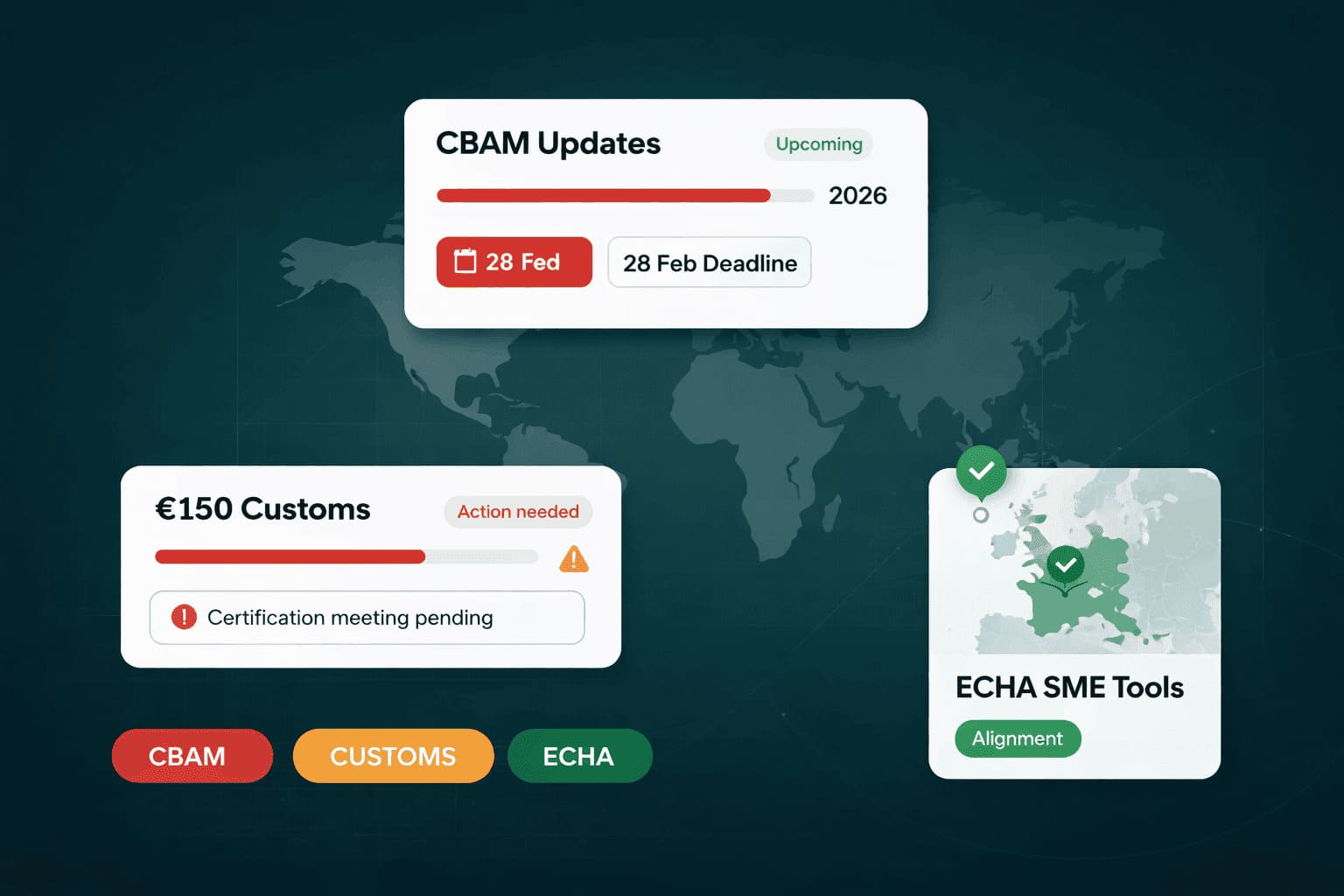
Table of Contents
Three EU compliance updates for 2026 will impact manufacturers and importers: CBAM simplifications, the end of the €150 customs duty exemption, and ECHA’s new SME digital tools.
🇪🇺 Simplifications for the Carbon Border Adjustment Mechanism (CBAM)
The latest simplifications to the Carbon Border Adjustment Mechanism (CBAM) were published on 20 October 2025 and entered into force following their signature by the European Parliament and the Council.
These adjustments, under "Omnibus I," aim to reduce the burden on small importers and exporters while enhancing the CBAM's ability to prevent carbon leakage. Key changes include streamlined reporting obligations, simplified authorization processes, and easier emissions calculations for importers.
Specifically, companies importing less than 50 tonnes of CBAM products per year will be exempt from these requirements. From 2027, default carbon prices for third countries with carbon pricing mechanisms will be incorporated into the CBAM framework, and methodologies for setting these prices will be published.
Statut: In effect — CBAM currently covers iron and steel, cement, aluminum, fertilizer, electricity, and hydrogen producers, with plans to expand its scope over time.
📌 What This Means for Manufacturers
- Importers under the 50-tonne threshold can potentially reduce or eliminate CBAM reporting, simplifying compliance operations.
- 2027 pricing reforms mean compliance teams must monitor third-country carbon mechanisms and how they intersect with CBAM.
- Now is the time to adapt emissions data reporting systems to align with the simplified frameworks and anticipate broader scope inclusion.
{{cta}}
🇪🇺 E-commerce: 150 EUR Customs Duty Exemption to End in 2026
Today, parcels valued at less than EUR 150 sent from a third country to a consumer in the EU are exempt from customs duties, although they are subject to VAT and require customs declarations. Given the evolution of the e-commerce model, the exemption is no longer justified and creates unfair competition.
The removal of the threshold aims to level the playing field between e-commerce (direct imports of individual parcels up to 150 EUR) and traditional retail (imports of goods in bulk).
This measure would be accompanied by a simple, temporary solution for the calculation of customs duties in the interim period, until mid-2028, when the EU Customs Data Hub will provide the functionalities for calculating the customs duties on e-commerce transactions.
Manufacturers and e-commerce sellers outside the EU will now be required to pay customs duties on all shipments valued at less than €150 destined for the EU.
Statut: Active enforcement — SMEs and platform sellers will have to replan their operations and adjust prices and logistics.
📌 What This Means for Manufacturers
- B2C sellers must reassess pricing strategies and logistics chains to incorporate new duty costs starting 2026.
- SMEs and platforms with high-volume low-value parcels should explore customs optimization or fulfillment center models inside the EU.
- Interim period (2026–2028) demands dual-tracking systems for customs calculation — teams should plan systems integrations accordingly.
🇪🇺 ECHA Launches SME Digital Support Tools
The SME hub contains online tools and materials from Member States and ECHA, including an AI-powered virtual assistant pilot. These online resources were presented today at the SME Assembly in Copenhagen, Denmark, held as part of the EU’s SME Week.
ECHA is piloting the use of artificial intelligence (AI) in its work.
In this case, we want to learn if AI can support SMEs in meeting their obligations under the EU chemicals legislation. This includes, for example, a webinar for SMEs from 22 October featuring AI-generated translations, and a pilot of an AI-powered virtual assistant. Available 24/7 in all EU languages, the assistant helps companies find reliable information about their duties by providing answers based on publicly available resources, including Q&As and other content from ECHA’s websites.
Statut: Active enforcement — The ECHA and the EU Commission have agreed to develop various strategies and regulations to make chemical regulations clearer, more understandable, and more enforceable.
📌 What This Means for Manufacturers
- Teams managing REACH, CLP, or SCIP obligations can use the AI assistant to speed up internal Q&A and documentation lookups.
- Non-EU manufacturers targeting EU entry should explore the assistant to clarify regulatory duties early in the GTM process.
- Compliance officers should monitor updates from the pilot to understand how AI will be embedded in ECHA workflows over time.
✅ Need to map these updates to your internal compliance workflows?
EcoComply’s AI-powered product compliance platform tracks every regulatory change in real time and turns them into clear, role-assigned actions. Reach out to explore how we automate reporting, alerts, and documentation — especially for complex regimes like CBAM and EU customs.
Related reading: Selling electronics in the EU: complete compliance guide for manufacturers and EU packaging EPR fees 2026: who pays, where, and how much.
Frequently Asked Questions
Everything you need to know about EU compliance

Do CBAM reporting obligations apply to you?
CBAM catches importers of certain goods, and once it applies the reporting is quarterly. We handle CBAM reporting alongside your other EU obligations rather than leaving it as a separate scramble.
- Whether CBAM applies to the goods you import
- Quarterly reporting prepared and filed
- Handled together with your wider EU compliance
Launch in the EU without compliance guesswork
Get a clear view of what documents you need, what’s missing, and how to avoid market access blockers, built for electronics & IoT manufacturers.
- Identify missing CE deliverables (DoC, test reports, technical file)
- Plausibility checks aligned with market surveillance expectations
- Expert validation for edge cases